
"Tents and shades" gets typed into Google together every day in the UAE — but most buyers don't actually know which one they need until a contractor walks them through it. The two products look related, sit in the same supplier catalogue, and use the same fabricators. They solve completely different problems.
This guide is the decision framework. By the end you will know — based on your property, your budget and how you plan to use the space — whether a tent, a shade, or a combination is the right answer.
The One-Sentence Difference
A tent is an enclosed structure built so people can be inside it. A shade is an open structure built so the sun can be blocked beneath it. Everything that follows in pricing, permitting, materials and maintenance flows from this single distinction.
If your project is fundamentally about creating a room (with walls, climate control, a sense of inside-vs-outside), you need a tent. If your project is about throwing a sun cover over something that exists already (a car, a garden seating set, a walkway, a pool deck), you need a shade.
Cost: How the Two Categories Compare
The price gap between tents and shades is wider than most buyers expect, and it runs in the opposite direction to intuition.
Tents Are More Expensive Per Square Metre
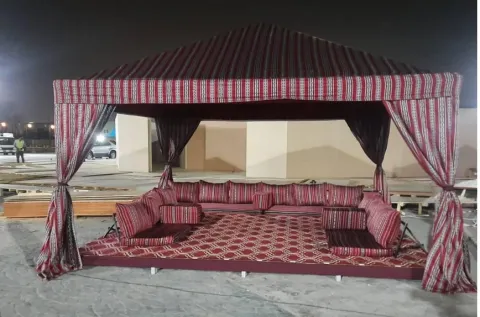
A standard 6 x 9 metre Arabic majlis tent in 2026 costs AED 7,000 to 12,000 supplied and installed in the UAE. That works out to roughly AED 130-220 per square metre of covered area. The price reflects the heavy fabric grade (450-650 gsm), the steel frame engineered to take wind load on closed walls, the interior fittings (carpets, cushions, lighting, ventilation) and the on-site assembly time.
Shades Are Cheaper Per Square Metre
A four-car cantilever parking shade covering roughly 50 square metres costs AED 8,000 to 15,000 supplied and installed. That works out to AED 160-300 per square metre of shade — but the comparison isn't fair because shades typically cover much larger total areas. A 200 sqm garden HDPE shade can come in under AED 100/sqm. Material is lighter, installation is faster, no walls to seal.
What This Means for Your Decision
If your budget is fixed, a shade gives you more covered ground. If your purpose requires an enclosed space (a real room, even a temporary one), a tent is the only honest answer regardless of price. Don't try to "cheap out" by buying a shade and adding walls later — patch jobs always look like patch jobs.
Use Case: When to Choose Each
Choose a Tent When You Need to Host People
- Ramadan iftar gatherings of 20+ people
- Weddings, engagement parties or family celebrations
- Bedouin majlis for receiving guests in traditional setting
- Corporate galas, product launches, exhibition booths
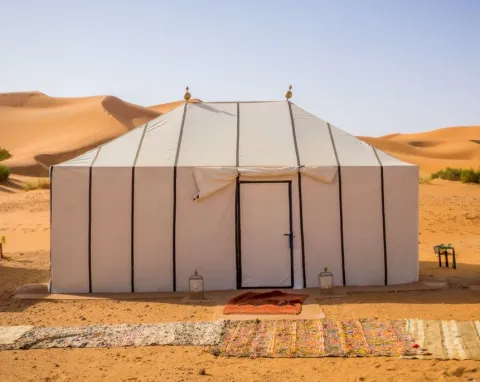
- Glamping units or desert overnight stays
- Private prayer space during Ramadan or Eid
For all of these, see our service catalogue for ready-made tents or custom tents.
Choose a Shade When You Need to Cover an Object or an Open Area
- Cars in your driveway, compound parking lot, or commercial fleet yard
- Garden seating, BBQ corner, kids' play area
- Pool deck, sunbed area, jacuzzi enclosure
- Walkways between villa and outbuildings, between apartment blocks
- Restaurant or café outdoor terrace
- School playground, sports court, training area
For all of these, browse our UAE shade solutions service.
Choose Both When You Have Mixed Needs
Most UAE villas end up with both. A typical configuration might be: a 4-car cantilever shade over the driveway, a louvre-roof pergola over the back patio, and a Bedouin majlis tent set up seasonally for Ramadan and family gatherings. The contractor can match colours and design language across all three so the property reads as one project, not three.
Materials: What Each Is Made Of
Tent Materials
Tent fabric is heavy, opaque and engineered to seal a space. The two dominant grades in the UAE are:
- Solution-dyed acrylic canvas (400-550 gsm): Breathable, fade-resistant, replicates the dark visual character of traditional beit al shaar. Best for Bedouin majlis tents and luxury event tents.
- PVC-coated polyester (500-650 gsm): Fully waterproof, fire-retardant, very durable. Best for permanent installations, palace tents and commercial event tents.
The frame is almost always galvanised steel for permanent tents, aluminium for portable or premium structures.
Shade Materials
Shade material is lighter and chosen for how it manages light, heat and air. The four dominant grades:
- HDPE knitted mesh (180-380 gsm): The most common car shade and garden shade fabric. UV blocks 85-95%, lets air pass freely, lets some diffused light through. Available in multiple colours.
- PVC-coated polyester (450-600 gsm): The same fabric used in tents, used here for shades that also need to be waterproof — like restaurant terraces or storage area covers.
- Polycarbonate sheet (4-16 mm twin-wall or solid): Rigid, transparent options, lets light through while blocking UV. Best for walkway shades where you want brightness underneath.
- Aluminium louvre slats: Rigid, adjustable, open-and-close mechanism. Premium pergola roofing.
Read the deeper material comparison in our car shade materials guide — the same trade-offs apply to non-car shades too.
Lifespan and Maintenance
How Long a Tent Lasts
A permanent or semi-permanent tent in the UAE has a fabric lifespan of 7-10 years and a frame lifespan of 15-25 years. Maintenance involves annual fabric tensioning, washing twice a year to remove dust and salt, inspection of all joints and fasteners, and immediate repair of any tears before they propagate. With proper maintenance you replace the fabric once before retiring the frame.
How Long a Shade Lasts
HDPE shade fabric typically lasts 5-8 years before UV degradation makes it brittle. PVC shade fabric lasts 8-12 years. Polycarbonate sheets last 10-15 years before yellowing reduces light transmission. Aluminium louvre roofs are essentially permanent — 20+ years with no functional decline. Steel frames again last 15-25 years with annual rust touch-up at any chips in the powder coating.
The Maintenance Cost Difference
A tent needs more attention because the fabric is structural — when it sags or tears, the whole interior loses its character and air-tightness. A shade fabric can sag a little without affecting function. Annual maintenance for a tent runs around 5-8% of original cost; for a shade, 2-4%.
Permits and Approvals
Tent Permits
A permanent tent on private property usually requires municipal building approval, treated similarly to any other small structure. In master-planned communities (Emirates Hills, Arabian Ranches, Dubai Hills, Khalifa City) you also need community management approval and may need to follow strict design guidelines for colours and proportions. Temporary event tents under 14 days generally need only civil defence fire safety clearance.
Shade Permits
Car parking shades and garden shades on private property in most UAE municipalities are treated as light structures and have streamlined approval — sometimes just a notification rather than a full permit. In compound communities the design guidelines often dictate exactly what colour, frame style and roof material is acceptable. Free-standing tensile structures and large public-area shades require full structural engineering submissions.
Work With a Contractor Who Handles Permits
The single most important question to ask any tents-and-shades supplier is whether they handle permitting as part of the project. Doing it yourself with no contractor support is painful, and a non-permitted structure can be ordered demolished by the municipality at any time.
Side-by-Side Decision Table
| Factor | Tent | Shade |
|---|---|---|
| Function | Enclosed space for people | Open coverage of an object or area |
| Walls | Yes | No |
| Typical size | 20-200 sqm | 20-1000+ sqm |
| Cost per sqm | AED 130-300 | AED 80-300 |
| Fabric weight | 450-650 gsm | 180-600 gsm |
| Fabric lifespan | 7-10 years | 5-15 years (material dependent) |
| Frame lifespan | 15-25 years | 15-25 years |
| Permit complexity | Higher | Lower |
| Annual maintenance | 5-8% of cost | 2-4% of cost |
| Best for | Hosting, ceremonies, private rooms | Cars, gardens, walkways, pools |
Frequently Asked Questions: Tents vs Shades
Can I use a shade as a tent if I add walls later?
You can, but you shouldn't. A shade is engineered for vertical sun load on an open structure. Adding walls changes the wind load profile dramatically — sometimes by 4-5x — and the original frame is rarely sized to take that. The honest answer is to specify a tent from the start if you need an enclosed space.
Is a pergola a tent or a shade?
A pergola is a shade. It has an overhead roof but no walls. Even if you fit it with retractable side curtains, it remains structurally a shade. Many UAE homeowners use a louvre pergola as a year-round outdoor sitting area and add a separate seasonal Bedouin tent for traditional gatherings.
Which lasts longer in the UAE climate, a tent or a shade?
The frames last about the same — 15-25 years for galvanised steel either way. The fabric on a shade often lasts longer because shade fabric is engineered for UV exposure as its primary job, while tent fabric is engineered for waterproofing and visual character. Aluminium louvre shades essentially last forever.
Can I install a tent or shade myself to save money?
Small portable tents and small DIY shade kits are sold in the UAE, but anything permanent or semi-permanent should be installed by a licensed contractor. Improperly anchored structures fail in summer storms — and a fabric structure that detaches from its frame in 100 km/h winds is a serious projectile hazard.
Should I get tents and shades from the same supplier?
Yes, almost always. A single supplier gives you matched design language, one project manager, one warranty, and usually a better total price than splitting the work. Arab Muzalat services covers both categories end-to-end.
The Final Decision in One Question
Ask yourself this: Will people be inside this structure, or will the structure be over something or someone outside it?
Inside means tent. Over means shade. Both means both — and that's normal for a UAE villa or compound. Get a single contractor to walk your property and quote the full installation. Visit our contact page to schedule a site visit anywhere in the UAE.