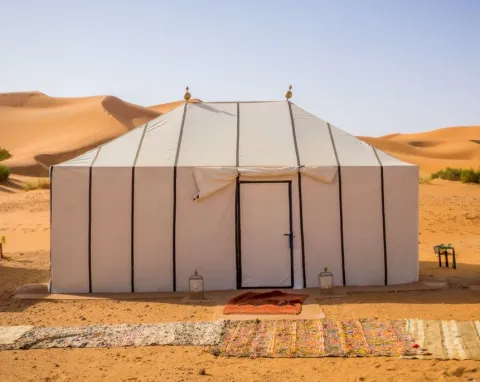

Building a majlis tent in the UAE is a project that ranges from a two-person afternoon job to a multi-day contractor engagement, depending on size and specification. A traditional Arabic pole tent for a family gathering requires a clear site, a set of poles, the fabric, and a team that knows the rope tension sequence. A fitted corporate majlis tent for 300 guests with air conditioning and lighting requires a structural engineer, an electrical contractor, and a project schedule. This guide covers the full range — construction method by construction method — with the material specifications that matter in UAE outdoor conditions.
Site Preparation
Before any frame or pole goes up, the site must be prepared. Skipping this step is the primary cause of uneven tent tension, pooling fabric, and poor drainage after a rain event.
Ground assessment
Sand and loose soil: stake depth must be a minimum of 600mm for any tent above 5m x 5m in exposed conditions. Wide-blade sand stakes or spiral ground anchors provide better holding than straight pointed stakes in loose material. For UAE desert surfaces, test stake resistance by pushing a standard tent peg to 300mm by hand — if it meets no resistance, use anchor corkscrew stakes or bury a deadman anchor (a stake or bar laid horizontally at 500mm depth with the guy rope attached at the centre).
Concrete or paved surfaces: surface-mount baseplate anchors using chemical anchor bolts into the concrete. Use M12 or M16 bolts with epoxy anchor compound. The concrete must be at least 100mm thick for reliable bond. Test each anchor before loading the frame.
Grass and soft earth: spiral corkscrew anchors to 600mm depth. Water the soil around the anchor point if the ground is very dry and friable — damp soil packs tighter around the anchor shaft and increases pull-out resistance.
Site levelling
A slope of more than 3 to 5 degrees across the tent footprint causes unequal tension in the fabric and a visually tilted ridge line. Level the site to within 50mm across the full footprint before erecting the frame. For permanent installations, a compacted gravel base or concrete pad ensures long-term level stability.
Drainage
Even in the UAE where annual rainfall is low, a single heavy shower event can dump 20mm of rain in 30 minutes. Plan drainage away from the tent footprint before installation. For tents with impermeable fabric roofs, route roof drainage to the perimeter and ensure a clear path away from the tent base into a drain or planting bed.
Frame Construction
Traditional Pole-and-Rope Construction
The construction sequence for a traditional Arabic ridge tent:
- Lay the roof fabric flat on the ground. Identify the centre of the ridge line.
- Place the centre ridge pole vertical under the ridge midpoint. Have one person hold the pole while another stakes the first two main ridge guy ropes — one forward and one rearward — at 45 degrees from the pole base to the ground. This creates an initial stable tripod.
- Raise the two end poles (smaller diameter than the centre pole) under the fabric at the two ridge ends. Stake their forward and rearward guy ropes immediately.
- Tension the ridge line by adjusting the main guy rope lengths until the fabric ridge is taut and straight.
- Stake the perimeter peg points — these hold the fabric eaves down and create the tent profile. Tension each peg point starting from the corners and working toward the midpoints of each side.
- Attach side wall panels (qata) at the rear and sides as required. Front face remains open by default.
Critical tension check: the ridge line should be straight with no sag. The fabric surface should be taut with no horizontal wrinkles. Vertical wrinkles at peg points indicate over-tensioning at that point — ease the peg back slightly.
Steel-Frame Modular Construction
Modern Arabic tents with factory-fabricated steel frames use a bolt-together assembly system:
- Lay out the base frame (bottom perimeter channel or base rail) on the prepared surface. Confirm it is square by measuring diagonal corner-to-corner dimensions — equal diagonals confirm a true rectangle.
- Stand the corner posts and mid-span posts in their base sockets. Connect the upper perimeter rails between posts.
- Install the ridge beam across the top of the frame from one end post to the other. This is typically the heaviest single component — two people for spans above 6m.
- Install the rafter members from the ridge beam down to the upper perimeter rail at specified spacings.
- Lay the roof fabric panel over the frame. On most modern Arabic tents, the roof panel uses a sleeve system — fabric sleeves slide over the rafter members — which holds the panel in place without separate fasteners.
- Attach the valance (decorative lower edge fabric) around the perimeter. Install side wall panels on the wall channels.
Fabric Selection and Specification
The fabric determines the appearance, temperature, durability, and maintenance requirements of the tent. Three categories are used in UAE majlis tents:
Traditional and Decorative Fabrics
Printed polyester canvas with traditional stripe patterns is the standard fabric for Arabic tent exteriors. Look for a minimum 300gsm weight for roof panels — lighter weights flutter and bag in wind. UV stabilisation is critical: the fabric should carry a stated UV resistance rating (minimum 3-year UV warranty, 5-year preferred). The stripe pattern — alternating red or green with cream or white — is the visual signature of the Arabic tent; the width and colour of the stripe can be customised for non-standard occasions.
HDPE Shade Fabric
For interior ceiling liners and decorative fabric suspended below the structural roof, woven HDPE in a single colour provides a clean ceiling that hides the structural frame and reduces the visual height. A 90% UV-block HDPE liner inside a tent with an open-sided configuration diffuses the incoming light to a soft ambient level, which is more flattering for an evening majlis gathering than the harsh contrast between direct sun patches and shade.
Decorative Event Fabrics
For fitted and premium majlis tents, the interior walls use draped fabric in stretch polyester or velvet-effect woven fabric. Burgundy, gold, emerald, and royal blue are the dominant colour choices for UAE event interiors. The fabric is typically pre-cut and sewn into panel sections that attach to the frame uprights by hook-and-loop tape or clip rail systems — allowing full reuse across multiple events.
Anchoring and Wind Stability
Wind is the primary structural threat to a majlis tent in the UAE. The shamal wind — a northwest prevailing wind — can reach sustained speeds of 25 to 35 km/h with gusts to 50 to 60 km/h. A tent structure must be anchored to resist these loads without requiring emergency intervention during a gathering.
Guy rope configuration
Traditional tents: minimum four main guy ropes per ridge pole (two forward, two rearward at 45 degrees) plus eight to twelve perimeter peg ropes around the eaves. For tents in exposed sites, add additional guy ropes at 90 degrees from the main poles — the cross-tension triangulates the pole against lateral wind loads.
Steel frame connection
For surface-mounted steel frame tents, anchor the frame at every baseplate position — not just corners. In wind events, an unanchored mid-span post lifts before a corner post, allowing the frame to rack and pull free from corner anchors. Chemical anchor bolts at every baseplate position is the safe specification.
Ballast weights
For tents on paved or indoor surfaces where drilling is not permitted, use ballast weight plates on each baseplate. The required ballast weight depends on the wind load calculation — for a standard 6m x 8m tent in an exposed UAE garden, minimum ballast is 80kg per corner post and 50kg per mid-span post.
Services Integration
A functioning majlis tent in UAE conditions typically requires three services to be integrated into the structure:
Lighting
Hanging glass lanterns (fawanees) are the traditional lighting element — suspended from the ridge line by chains or hooks at 1.5 to 2m intervals. For event lighting, LED strip lights along the frame rafters provide adjustable ambient light. Spotlights mounted on external frames directed into the tent create theatrical uplighting. All electrical connections in outdoor tents must be IP65-rated minimum — the UAE humidity and dust environment damages non-sealed connectors rapidly.
Air conditioning or cooling
For summer events, at minimum one portable evaporative cooler per 20 to 25 square metres of tent area. For a fully air-conditioned tent, split or portable air conditioning units at the perimeter walls with a sealed interior liner to prevent cool air escaping through the fabric. Calculate 250 to 350 watts of cooling capacity per square metre for a fully exposed tent in July conditions in the UAE.
Flooring
The floor treatment defines the majlis character as much as the tent itself. Traditional rugs and carpets on compacted sand or soil are appropriate for outdoor desert settings. For villa gardens and event venues, interlocking event floor tiles over the paving provide a level surface for rugs and furniture. A raised wooden platform with a carpeted surface creates the traditional elevated seating character seen in formal majlis interiors.
Frequently Asked Questions
Do I need a structural engineer to build a majlis tent in the UAE?
For standard residential-scale Arabic tents (up to 8m x 12m) installed by experienced tent contractors, a formal structural engineer sign-off is not typically required. For tents above 150 square metres, for tents with air conditioning loads on the frame, or for tents installed in exposed coastal locations, an engineer review of the anchor design is advisable.
How do I prevent the tent fabric from sagging in UAE heat?
Fabric sag results from under-tensioning at installation combined with thermal elongation of the fabric in high temperatures. At initial installation, tension the fabric firm — tighter than feels comfortable — to allow for the relaxation that occurs when the fabric heats up. Re-tension any visible sag within 48 hours of initial installation.
What is the minimum anchor depth for a majlis tent on sandy UAE desert ground?
600mm minimum for standard straight tent pegs on compacted sand. On very loose dune sand, use spiral corkscrew anchors to 800mm or deadman anchors — a horizontal bar or stake buried at 600mm depth with the guy rope attached to its midpoint. Test each anchor by applying load before connecting the tent frame.
Contact Arab Muzalat for majlis tent construction and installation across the UAE — full service from site assessment and frame supply through to fabric selection, anchoring, and services integration.