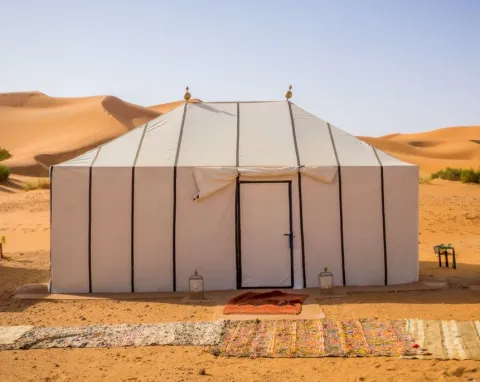

The Design Challenge of a UAE Majlis
Designing an Arabic majlis in a modern UAE villa or apartment is not simply a matter of buying the right furniture. It requires understanding the spatial logic of the majlis tradition and translating it into a room that may be very different from the traditional proportions of a Bedouin home. This guide covers every design decision in sequence — starting from the room itself and working outward to the accessories.
Step 1: Assess the Room and Its Role
Before any design decisions, establish the fundamental parameters of your majlis room:
- Dedicated or dual-purpose? Is this room used exclusively as a majlis, or does it double as a family sitting room? A dedicated majlis can be more formal and less flexible in its furnishing. A dual-purpose room needs seating that serves daily family use as well as guest reception.
- Male, female, or mixed? Traditional Emirati households maintain separate male and female reception spaces. If your majlis serves a mixed household or you want one room to handle all reception needs, the furnishing style should be more neutral and versatile.
- Room dimensions: Measure total wall lengths, ceiling height, door and window positions, and any architectural features (archways, alcoves, columns) that affect the seating run.
- Traffic flow: Where is the entrance? The most honoured seating position is always furthest from the entrance. The seating layout must allow guests to reach any seat without climbing over others — keep the central floor space clear.
Step 2: Choose the Seating Layout
The layout of the perimeter seating is the most consequential single design decision in a majlis. The main options for UAE villa rooms:
Full Perimeter (U-Shape or Three-Wall)
Seating covers three walls — the wall facing the entrance and both side walls. The entrance wall is left clear for traffic flow. This is the most traditional and formal layout, best suited to rooms 5 x 5 m and larger. It creates the strongest sense of a dedicated reception space where all guests face inward and the host can see and address everyone.
Two-Wall L-Shape
Seating covers two adjacent walls. The most practical choice for rooms under 5 x 5 m or in villas where the majlis room is a converted bedroom or secondary space. Preserves more open floor area and feels less formal — appropriate for households where the majlis doubles as a family room.
Parallel Rows
Two facing rows of seating along the two longest walls, with open ends. Common in long, narrow majlis rooms and in formal tribal or government reception settings. Creates a more formal, structured interaction dynamic where guests on opposing sides of the room maintain direct eye contact.
Step 3: Specify the Seating Dimensions
The seating specification determines how comfortable the majlis feels and how much floor area it occupies:
- Seat height from floor: The authentic Emirati low-seating style is 12 to 18 cm. This is comfortable for guests accustomed to floor seating but can be challenging for elderly guests or those with knee problems. A modern compromise is 22 to 28 cm — still noticeably lower than a standard sofa but accessible for all ages.
- Seat depth: 60 to 70 cm is standard. Deeper seats (75 cm) allow guests to lean back against the wall cushion with legs stretched out — very comfortable for long evening gatherings.
- Back cushion height: The back cushion should sit against the wall and support the mid-back. A total seating height (floor to top of back cushion) of 85 to 100 cm is standard for UAE majlis spaces.
- Corner treatment: Rounded corners are more comfortable and look softer; square corners use floor space more efficiently. For a large formal majlis, square corners with mitre-cut cushions create a more structured, architectural appearance.
Step 4: Select the Fabric and Colour Palette
The fabric choice defines the majlis-s character more than any other single element. UAE majlis design uses two main colour approaches:
Traditional Rich Palette
Deep jewel tones — royal blue, burgundy, forest green, aubergine — in velvet or brocade fabric. Gold or silver piping and tassels. Embroidered or button-tufted back panels. This palette communicates heritage, formality, and celebration. It works well against off-white or cream walls and marble or polished tile floors.
Contemporary Neutral Palette
Warm neutrals — sand, taupe, ivory, warm grey — in performance velvet or textured linen-look fabric. Minimal trim, clean lines, no tassels. This palette suits modern villa interiors with a more international design sensibility. It is easier to live with daily and accepts bold accent colours in the scatter cushions and carpet.
Step 5: Choose the Flooring
The floor treatment in a UAE majlis serves two functions: it defines the social space and it provides comfort for low-seating use.
- Persian or Khorasan carpet: The traditional choice. A large, high-pile carpet (12 to 20 mm pile) in a geometric or medallion pattern placed centrally in the room. The carpet should extend at least 30 cm beyond the front edge of the seating on all sides and stop at least 20 cm from the walls.
- Fitted wall-to-wall carpet: Used in many UAE villa majlis rooms for a seamless, easy-care surface. Lower pile height (8 to 12 mm) for easier maintenance. Works well with the neutral contemporary palette.
- Polished marble or porcelain with area rug: A hard floor with a large area rug centred in the room. The hard floor reflects light upward, enhancing the richness of velvet seating; the area rug provides warmth and comfort underfoot.
Step 6: Design the Lighting
Majlis lighting in the UAE should be warm and layered — never harsh or flat:
- Central chandelier: The focal point of the ceiling. For a 5 x 5 m majlis, a chandelier of 70 to 90 cm diameter is appropriate. For a 7 x 7 m or larger room, 100 to 150 cm. Choose warm-white bulbs (2,700 to 3,000 K) — cold white destroys the warmth of velvet and brocade.
- Perimeter cove lighting: Indirect LED strip lighting in a ceiling cove or behind a cornice creates a soft glow that emphasises the height of the room. Best in warm amber or gold-tinted strips.
- Wall sconces: Decorative sconces above the seating line add a layered, residential quality. Moroccan-inspired punched-metal lanterns or Arabic arch-profile sconces suit the aesthetic.
- Avoid: Recessed downlights (spots) pointed directly at the seating area — they cast unflattering shadows on guests and make the space feel like a retail fitting room rather than a reception room.
Step 7: Dress the Walls
The wall above the seating line is the display space of the majlis. In UAE villa majlis rooms:
- One large centrepiece — a framed verse of Quranic calligraphy, a heritage landscape, or a geometric art panel — on the wall opposite the entrance or above the host-s seating position establishes the room-s identity.
- A framed photograph of the ruling family or a portrait of a respected elder is traditional in many Emirati households.
- Wall panels should be hung at a height that is visible from the seated position — the centre of the frame at approximately 150 cm from the floor works for most majlis seating heights.
Step 8: Complete with Accessories
The final layer of a well-designed UAE majlis:
- Scatter cushions (مرافيق): 45 x 45 cm or 60 x 60 cm in matching or complementary fabric. Allow 6 to 8 per wall of seating.
- Coffee service table: A low round table (height 30 to 40 cm) in the centre of the majlis with a dallah, finjan tray, and a plate of dates and dried fruits set ready at all times when the majlis is in use.
- Mabkhara: A dedicated incense burner — ceramic, silver, or brass — on a stand near the entrance.
- Tissue box cover: A decorative tissue box cover on the coffee table is a standard element of a furnished UAE majlis — choose one that coordinates with the majlis colour palette.
Design Your Majlis with Arab Muzalat
Arab Muzalat offers a complete majlis design and furnishing service for UAE villas and apartments. Our team handles measurement, seating specification, fabric selection, carpet sourcing, and full installation. Contact us to book a free in-home consultation and receive a comprehensive design proposal for your majlis space.