Tents and shades are the two largest categories of outdoor structures installed in the UAE every year, and most homeowners and project managers underestimate just how different they are from each other. A tent is enclosed and made for people. A shade is open and made to block the sun. The decisions you make in each category — material, frame, structure type, size and finish — change the price, the lifespan and the look of the final installation.
This pillar guide covers every category of tent and every category of shade you will encounter in the UAE in 2026, when each one is the right choice, and how each one is built. By the end you will be able to ask suppliers the right questions and judge whether a quote is fair.
The Two Families: Why Tents and Shades Are Sold Together
Almost every UAE supplier of outdoor structures groups tents and shades into a single business. There are two reasons for this. First, the structural craft is identical — the same steel fabricators, fabric cutters, riggers and installation crews build both. Second, customers usually need both: a villa that orders a Bedouin tent for the back garden almost always orders a car shade for the driveway in the same year.
The trade name "khiam wa muzallat" (خيام ومظلات) reflects this combined market. When you search for it, you are usually looking for a single contractor who can deliver everything outdoor — from a 12-metre wedding tent to a four-car cantilever shade — under one design language and one project manager.
Category One: Tents — Enclosed Structures for People
A tent is a fully enclosed fabric structure with a frame, walls and a roof, designed for people to sit, sleep, eat or gather inside it. The four tent families dominant in the UAE in 2026 are Arabic Bedouin tents, Pakistani tents, palace tents and majlis tents.
Arabic Bedouin Tents (Beit Al Shaar)
The classic dark-coloured Arabian tent built around the silhouette of the traditional beit al shaar. Modern versions use solution-dyed acrylic canvas or PVC-coated polyester over a galvanised steel frame. They are the default choice for Ramadan majlis setups, Eid family gatherings, royal events and any project where Emirati cultural identity matters. Read our deep dive on Bedouin tents from tradition to modern luxury for the full background.
Pakistani Tents
Pakistani-style event tents are large, brightly decorated structures with elaborate interior linings, mirrored panels and ornamental skirting. They are popular for South Asian weddings, mehendi nights and community events across Sharjah, Ajman and Dubai. We explain the structural differences in Pakistani tent vs Arabic tent.
Palace Tents
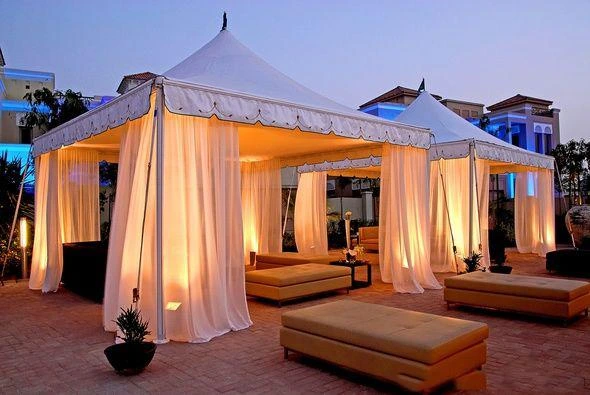
Palace tents are high-grade event structures with reinforced aluminium or steel frames, clearspan interiors of 15-40 metres, hard or soft walls, climate control, glass walls or doors, and full event-grade flooring. They are the format used for royal weddings, government events, large corporate galas and luxury exhibitions.
Majlis Tents
A majlis tent is a smaller, semi-permanent structure designed specifically for the Arabic majlis function — receiving guests in a long, perimeter-seated room. It can be a Bedouin-style tent fitted with majlis cushions, or a modern fabric structure with majlis interior. Ready-made majlis tents are available in standard sizes for villa gardens.
Category Two: Shades — Open Structures for Coverage
A shade is an overhead structure that blocks sun, rain or both, but does not enclose a space. There are no walls. The point of a shade is to let air, view and movement pass freely while reducing surface temperature underneath by 10-15°C. UAE shade categories break down by use case.
Car Parking Shades
The most common shade installation in the UAE. Car shades protect vehicles from direct sun, sand-blast erosion of the paint, and interior heat damage. The five main structural types — cantilever, H-frame, arch, T-frame and sail — each have specific use cases. Our guide to car shade structure types compares all five.
Garden and Walkway Shades
Garden shades cover seating areas, play zones, BBQ corners, walkways between buildings and pool decks. Materials range from HDPE knitted fabric to solid polycarbonate sheeting. Read the full garden shade structures guide for the material trade-offs.
Pergolas and Aluminium Louvre Roofs
A pergola is a structural shade with rigid roof slats — wooden, aluminium, fixed or motorised. Modern UAE villas increasingly install motorised aluminium louvre roofs that close fully against rain and open to let breeze through. See our pergola design service for the configurations available.
Retractable Awnings and Motorised Shades
Awnings and motorised shades extend or retract on demand. They are used over windows, balconies, café terraces and pool decks where the homeowner wants flexibility — full sun in winter, full shade in summer, retracted in storms. Our remote-control retractable awnings service covers the full range.
Sail Shades and Tensile Structures
Sail shades are triangular or quadrilateral fabric panels stretched between high anchor points. They give a modern, architectural look and are popular for pool areas, rooftop terraces and commercial entrances. Tensile structures scale this idea up to large-span coverage of plazas, public spaces and mall walkways.
How Tents and Shades Are Built: The Common Engineering
Despite serving different functions, tents and shades share most of their construction engineering. Understanding this helps you compare quotes intelligently.
Frame
The frame is the load-bearing skeleton. Galvanised steel (powder-coated for finish) is the standard for both tents and shades in the UAE because it survives 50°C summers, sandstorms and salt air without rusting. Aluminium is used for premium pergolas, palace tents and any installation where weight or visible architecture matters. Wooden frames are decorative only — never structural in serious UAE installations.
Fabric or Roof Material
This is where tents and shades diverge. Tents use heavyweight (450-650 gsm) PVC-coated polyester or solution-dyed acrylic canvas because the fabric forms an enclosure and must seal out wind and rain. Shades use lighter materials chosen for their light-management properties: HDPE knitted mesh (95% UV blocking, breathable), polycarbonate sheets (rigid, transparent options), or aluminium louvre slats (rigid, adjustable). Our service page on tent and shade fabrics walks through every grade.
Anchoring
The anchoring system holds everything down against UAE wind loads, which can exceed 120 km/h in summer storms. Permanent installations are bolted into reinforced concrete footings sized to the structure's overturning moment. Semi-permanent installations use ballast blocks. Event tents use stake-and-rope or weighted skirts depending on whether the ground accepts driven stakes.
Choosing the Right Tents and Shades for Your Property Type
The same tent or shade product can be right for one property and wrong for another. Use this matrix as a starting framework.
For UAE Villas
- Driveway: 2-4 car cantilever shade, structural steel frame, HDPE or aluminium roof. Should match villa facade colours.
- Garden: Pergola or louvre roof over the seating area. Bedouin majlis tent for traditional gatherings (seasonal or permanent).
- Pool deck: Sail shade, retractable awning, or fixed pergola depending on architectural style.
- Side yard / staff area: Simple HDPE flat shade for laundry, storage or service access.
For UAE Compounds and Apartment Buildings
- Common parking: Multi-bay H-frame or arch shade, pre-fabricated, polycarbonate or HDPE roof.
- Walkways: Linear walkway shade with polycarbonate roof, painted steel structure matched to building colour.
- Pool and gym entries: Sail shade for visual identity, fabric awning for entry doors.
- Communal majlis area: Permanent semi-tent structure with majlis interior for community gatherings during Ramadan and national holidays.
For UAE Businesses and Public Sites
- Restaurant terraces: Aluminium louvre roof or motorised pergola for year-round use.
- School playgrounds: Large-span tensile shade with high UV rating, fall-zone-rated supports.
- Mall entries and event plazas: Architectural tensile shade or sail combination, designed by a structural engineer with municipality approval.
- Construction sites and workshops: Industrial-grade fabric shelters with PVC walls, concrete-anchored frames.
How to Specify a Tents and Shades Project Properly
Most disputes between UAE customers and tent or shade contractors come from poor specification at the start of the project. A good brief covers the following before any quote is signed.
- Function: Exactly who or what sits under the structure, how many of them, how often.
- Location: Address, surface type (sand, paving, concrete, grass), and exposure (open desert, walled compound, coastal).
- Dimensions: Length, width, clear height under the lowest beam, and overhang clearance from buildings.
- Material grade: Specific fabric weight in gsm, frame metal type and thickness, hardware finish.
- Wind rating: Required wind resistance in km/h. The UAE municipality minimum is usually 120 km/h for permanent structures.
- Permits: Whether municipality, master community or HOA approval is required. The contractor should handle this.
- Lifespan and warranty: Expected useful life of fabric (typically 5-10 years), frame (15-25 years), and what is covered under warranty.
- Maintenance plan: Annual cleaning, rust touch-up, fabric tensioning and bolt inspection schedule.
Frequently Asked Questions About Tents and Shades in the UAE
Are tents and shades the same thing?
No. A tent is an enclosed structure with walls and a roof, designed for people to sit or live inside. A shade is an open structure designed only to block the sun. The frame engineering and supplier base overlap, which is why they are sold together, but the products solve different problems.
Do I need a permit for a tent or shade in the UAE?
Permanent installations on private property usually need municipal approval, especially in master-planned communities like Emirates Hills, Arabian Ranches or Khalifa City. Temporary event tents under 14 days generally do not need a permit but may require fire safety clearance from civil defence for indoor events. A reputable supplier will tell you upfront which permits apply and will handle them as part of the project.
What is the lifespan of a tent or shade in the UAE climate?
A galvanised steel frame with proper powder coating lasts 15-25 years. PVC-coated tent fabric lasts 7-10 years before needing replacement. HDPE shade fabric lasts 5-8 years depending on UV rating. Aluminium louvre slats last 20+ years with minimal degradation. Annual maintenance roughly doubles the practical lifespan of the fabric components.
Can the same supplier handle both a tent and a shade installation?
Yes. The UAE market is set up so that a single contractor like Arab Muzalat handles design, fabrication, installation and maintenance for both tent and shade categories. Using one supplier simplifies project management, gives you consistent design language across the property, and usually gives you a better price than splitting the work between two specialists.
Should I buy or rent a tent in the UAE?
If you need the tent more than four times in a year, owning is cheaper over a three-year horizon. If it is for a single wedding or one-off corporate event, renting wins. We covered this in detail in Majlis tent: rent or buy.
Working with Arab Muzalat
Arab Muzalat is a UAE contractor specialising in custom tents and shades across all seven emirates. The company designs, manufactures and installs Arabic Bedouin tents, Pakistani event tents, palace and majlis structures, car parking shades, garden pergolas, retractable awnings, sail shades and tensile architecture. Every project starts with a free site survey, a written specification and a clear written quote with no hidden additions.
Browse the full service catalogue at Arab Muzalat services or contact us directly via the contact page to schedule a site visit anywhere in the UAE.

