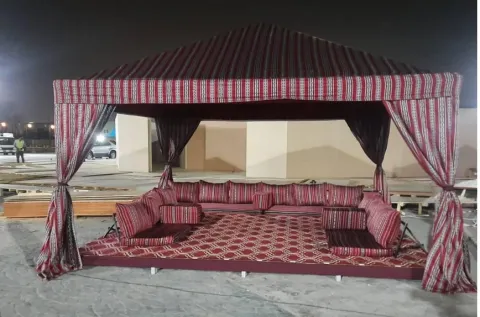

What Makes Goat Hair Different
Traditional black Bedouin tents — bayt al-sha'ar in Arabic, literally "house of hair" — are woven from the coarse, long-fibered hair of black goats. The fiber has two properties no synthetic replicates well: it swells when wet, pulling the weave tight and shedding rain, then opens as it dries to create airflow in dry heat. In a UAE summer, that self-regulating behavior keeps interior temperatures noticeably lower than under nylon or polyester canvas.
Reading the Weave
When you inspect a goat hair tent, look at the weave density in the center panels — these carry the most UV and heat load. A tightly woven panel (around 200–250 g/m²) looks nearly uniform when held up to daylight. A loose weave shows visible gaps — fine for mild weather, but it will admit dust and let rain through. Most UAE-sold tents use a blend: denser panels at the top (shiqa) and looser side walls (ruwaq) for cross-ventilation.
Panel Structure
A properly configured bayt al-sha'ar consists of:
- Shiqa (شيقة): the main woven roof section running along the ridge
- Ruwaq (رواق): the woven side walls, which roll up or tie back for ventilation
- Ata (عطا): the rope and peg system, traditionally goat or camel hair cord — modern versions use polypropylene
- Center poles (awad): traditionally ironwood, now commonly powder-coated steel
Sizes Available in the UAE
Goat hair tents are measured by shiqa panel count. A typical panel is 60–70 cm wide:
- 3-shiqa (~2 m × 4 m): small majlis or photography prop
- 5-shiqa (~3 m × 7 m): family gathering or farm corner
- 7-shiqa (~4 m × 9 m): mid-size event or permanent heritage installation
- 10+ shiqa (6 m × 12 m and above): large tribal or festival setup, requires additional center poles
Custom widths are possible — the loom sets the panel width but the tent maker can add panels. Allow 4–6 weeks for a custom commission; most looms are in Jordan, Saudi Arabia, and Morocco.
What to Check Before You Buy
- Fiber content: ask for pure goat hair or a declared goat/camel blend. Some cheaper tents substitute sheep wool, which lacks the rain-shedding and ventilation properties. Sheep wool feels softer — real goat hair is coarser.
- Seam reinforcement: shiqa panels should have double-stitched seams with leather or canvas patches at stress points (pole pockets, ridge junctions).
- Rope quality: polypropylene ropes are fine. Cheap nylon cord stretches overnight and the tent sags by morning — replace before first setup.
- Pole diameter: for 5-shiqa or larger, center poles need a minimum 50 mm diameter. Thinner poles bow under ridge tension.
- Odor: a new goat hair tent has a distinct lanolin smell that fades after the first few outdoor uses. A heavy chemical odor suggests the fiber was bleached or dyed to hide poor quality.
Price Ranges in the UAE (2026)
- 3-shiqa basic: AED 800–1,500
- 5-shiqa standard: AED 2,000–4,000
- 7-shiqa traditional quality: AED 4,500–8,000
- 10+ shiqa premium commission: AED 10,000–25,000+
Price variation reflects fiber quality, weave density, and whether poles and ropes are included. Always clarify what is and is not in the quoted price.
Who Buys Them in the UAE
Today's buyers break into three groups: farms and istirahat in RAK, Fujairah, and Al Ain who want a permanent cultural focal point; event and hospitality operators who use them for themed dinners, Ramadan activations, and heritage festivals; and homeowners in Dubai and Abu Dhabi who want a majlis tent for the garden that signals Bedouin identity rather than generic rental decor.
Order Your Bayt Al-Sha'ar
Arab Muzalat supplies and installs goat hair tents across the UAE. We work with established weavers and advise on size, pole configuration, and anchoring for your specific site — sandy ground, paved garden, or concrete farm floor.