
A garden in the UAE without shade is an investment that sits unused from May through September. The sun angle in Dubai between 10am and 4pm during summer makes any exposed outdoor surface functionally off-limits — paving stones exceed 60 degrees, unshaded seating areas become too hot to touch, and plant cover burns unless specifically selected for full desert sun. Adding a shade structure does not just make a garden more comfortable. It makes it usable for most of the year rather than half of it.
The challenge is that garden shade structures in the UAE need to do more than block sun. They need to survive sustained UV radiation, salt-laden air in coastal areas, occasional sandstorms, wind gusts, and the structural stress of heavy shade fabric in humid summer conditions. Every material choice and structural design choice carries consequences for lifespan, maintenance, and performance in this specific environment.
This guide covers every garden shade type available in the UAE market with honest assessments of where each performs well and where it falls short.
Type 1: Pergola with Shade Roof (برقولا مع سقف)
The pergola is the most widely installed garden shade structure in UAE villa gardens. The basic form is a freestanding or wall-attached frame — four posts, two side beams, and a set of rafters — with a roof covering applied across the rafter span.
Frame materials
Aluminium: The dominant choice for UAE pergolas. Aluminium does not rust, does not need periodic repainting, and handles salt air without degradation. Powder-coated aluminium in RAL colours integrates cleanly with contemporary villa architecture. Section sizes for a standard 4m x 5m pergola: 100mm x 100mm posts, 80mm x 40mm rafters. Weight is low enough that the pergola can be surface-mounted on existing paving slabs using baseplate anchors, avoiding the need to break and re-lay paving.
WPC (Wood-Plastic Composite): WPC profiles look like timber but contain no organic material — they are extruded from wood fibre and polyethylene. They do not rot, do not splinter, and do not need sealing or staining. In UAE outdoor conditions, WPC holds colour and surface texture for 10 to 15 years before visible fading. The visual warmth of a WPC pergola suits villa gardens with natural stone or planted landscaping more than an aluminium frame does. Structural limitation: WPC sections are not as strong as aluminium under span loads — maximum rafter span without mid-support is typically 2.5m to 3m for standard profiles.
Galvanised steel: Stronger than aluminium or WPC for large spans, but requires powder coating or painting to resist rust in humid coastal conditions. More common for industrial or large-scale shade applications than residential villa gardens. Heavier — requires concrete footings rather than surface-mount bases for any significant span.
Roof covering options
HDPE shade fabric: Knitted high-density polyethylene fabric in a 90% UV-block weave is the standard roof covering for pergolas in UAE villa gardens. It allows air to pass through (critical for reducing the heat buildup under the structure), weighs around 300 to 500 grams per square metre, and comes in a wide range of colours from neutral beiges and greys to greens and earth tones. Service life: 8 to 12 years with UV stabilisation. Not waterproof — rainfall passes through, which is acceptable for most UAE gardens given the low annual rainfall.
Twin-wall polycarbonate: A solid transparent or tinted panel that provides full rain protection and significant UV blocking. The colour temperature under opal white polycarbonate is soft and diffused — preferable to the harsh shadows under HDPE fabric. Bronze and grey tinted panels reduce solar heat transmission. The limitation in UAE conditions: polycarbonate expands and contracts significantly with temperature swings. Panels on a pergola roof can warp or crack at fastener points if the mounting system does not allow for movement. Service life: 10 to 15 years for quality twin-wall or multiwall grades.
Louvre slats (fixed or adjustable): Aluminium or WPC louvre slats laid across the rafter span create a partially open roof with controlled shade lines. Fixed louvres set at a specific angle block direct overhead sun while allowing filtered light and partial airflow. Adjustable louvre systems use a rod-and-pivot mechanism to rotate all slats simultaneously — opening the roof fully for stargazing at night, angling them for morning sun, and closing them to near-full shade in peak afternoon heat. Adjustable louvres are the premium choice for UAE entertainment pergolas.
Best applications
Pergolas with shade roofs suit covered patio areas adjacent to the villa, garden dining and seating areas, poolside coverage where rain protection is not the priority, and walkway connections between separate outdoor zones.
Type 2: Shade Sail and Tensile Canopy (شراع الظل والمظلة الشدية)
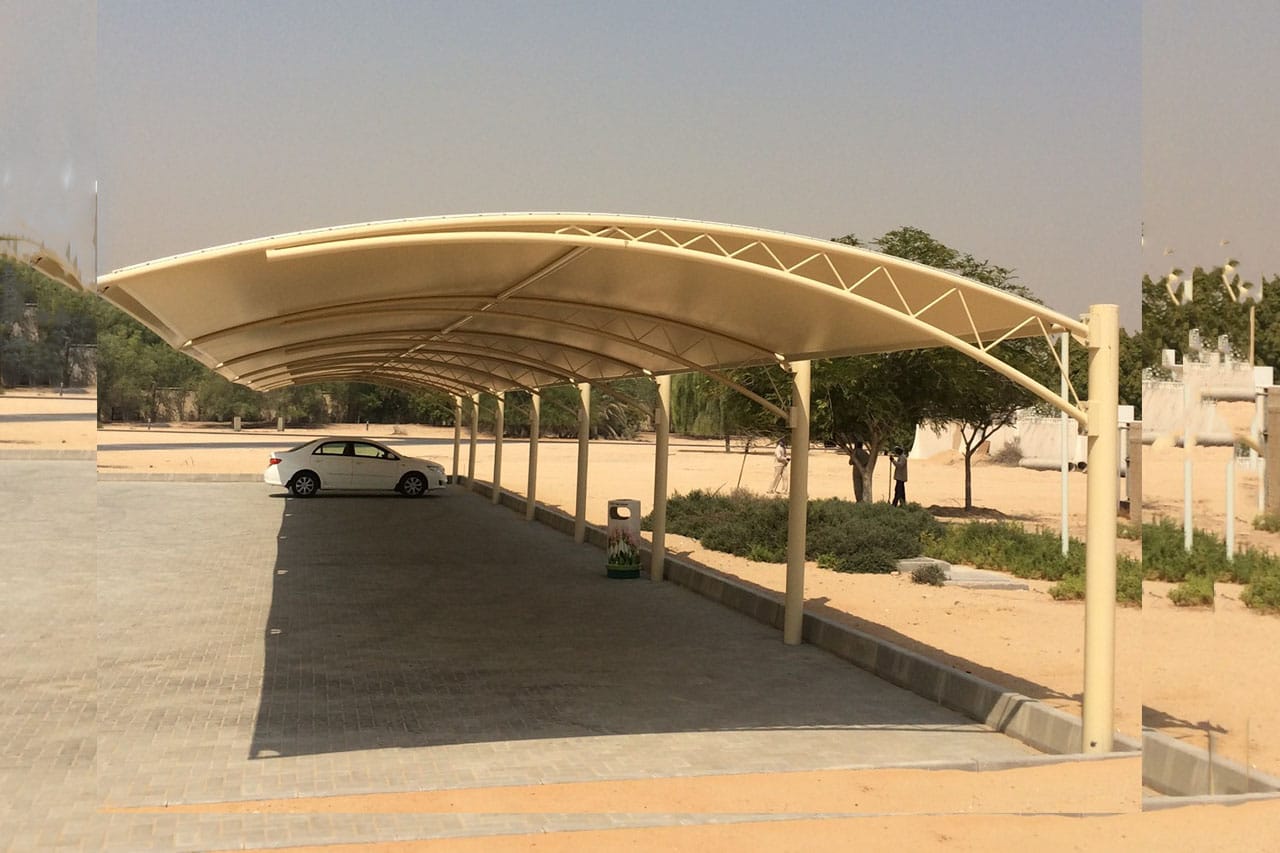
Shade sails are flat or gently curved fabric membranes pre-cut to a specific polygon shape — triangle, square, or rectangle — and tensioned between anchor points. Tensile canopies are similar but typically larger, engineered with specific hyperbolic or saddle geometry, and tensioned to a calculated stress distribution.
Materials
HDPE shade fabric: The most common material for residential shade sails. A shade sail over a 4m x 4m pool area uses approximately 18 to 20 square metres of fabric. Quality shade sail fabric in the UAE should carry a minimum 3-year UV warranty — cheaper imported fabric from non-UV-stabilised HDPE fades and becomes brittle within one to two seasons.
PVC coated polyester: Fully waterproof, heavier, and more dimensionally stable than HDPE. Used for shade sails in areas where rain protection matters, and for tensile canopies on commercial and event installations. Architectural grades from manufacturers like Serge Ferrari or Mehler carry 10-year warranties against UV degradation.
Structural requirements
Shade sails require anchor points that can handle both the deadweight of the fabric and the dynamic tension loads from wind. In UAE conditions, a properly tensioned shade sail over a villa garden generates anchor forces of 500 to 1,500 kilograms on each connection point, depending on sail size and wind exposure. Wall brackets embedded in the villa structure, freestanding steel mast posts with concrete footings, or purpose-built steel columns are all used as anchor points. The anchor design must be specified by an engineer for sails above 20 square metres — undersized anchors pull out of walls and the sail collapses.
Best applications
Shade sails work well for pool areas where posts can be positioned around the perimeter, children play areas, garden sections where an unobstructed floor is needed (shade sail posts at the perimeter rather than in the activity zone), and large garden areas where a traditional pergola frame would visually overwhelm the space.
Type 3: Motorised Louvre Roof (سقف اللوفر المتحرك)
A motorised louvre roof is a pergola-style frame with aluminium blade slats that rotate on a motor-driven shaft. A single button or app command opens the blades (full open sky), angles them for partial shade, or closes them to create a near-waterproof roof. LED lighting strips embedded in the frame rafters create an illuminated garden space at night. Side screens — motorised fabric or polycarbonate — can enclose the structure on three sides.
Motorised louvre roofs are the highest-specification outdoor shade structure in the UAE villa market. They eliminate the trade-off between shade and airflow — the louvre angle can be adjusted throughout the day to track the sun — and the waterproof-when-closed capability means the space under the louvre roof can be used during UAE rain events without furniture damage.
Limitations
Cost is significantly higher than a standard pergola with fabric roof — typically three to six times more per square metre. The motorised mechanism requires annual maintenance: blade pivot lubrication, motor inspection, seal condition check. In a dusty UAE environment, fine sand infiltrates blade pivot points and accelerates wear if not cleared regularly. Not suitable for installations in exposed high-wind locations without additional tie-down engineering.
Best applications
Entertainment terraces on large villa plots, pool decks where a weather-sealed roof adds significant usability, outdoor dining areas that need to function year-round, and high-end properties where the visual specification of the outdoor space matches the interior.
Type 4: Freestanding Garden Gazebo or Pavilion
A gazebo is a freestanding octagonal or hexagonal structure with a pitched roof. A pavilion is typically rectangular with a hip or gabled roof. Both create a defined covered outdoor space in the garden that functions independently of the villa structure — they can be positioned in the middle of a lawn, at the edge of a pool, or at the far end of a walled garden.
Materials
Aluminium frame with polycarbonate or metal roof: The contemporary approach — clean lines, no maintenance, long service life. Aluminium gazebos can be powder-coated to match villa colours. Polycarbonate roof panels in multiwall grade provide rain protection and diffused light.
WPC frame with thatched or tile roof: For gardens with a tropical or natural aesthetic, a WPC-framed gazebo topped with treated palm frond thatch (nakheel) or terracotta tiles creates a distinctive focal point. Thatch roofs in UAE conditions require replacement every 3 to 5 years due to UV degradation.
Steel frame with fabric canopy: A lightweight galvanised steel frame with a stretched HDPE or canvas canopy. More affordable than aluminium or WPC construction. Less durable but suitable where the structure will be relocated or replaced within 5 to 8 years.
Best applications
Garden focal points at the end of a planting axis, outdoor seating areas distinct from the main patio, pool-side shelters, and children play areas in large villa gardens.
Type 5: Retractable Awning for Garden Use (مظلة قابلة للطي للحديقة)
A retractable awning mounts against the villa wall and extends over the adjacent garden or patio area. In its retracted position it folds into a casing at the wall. When deployed, it creates a fabric roof over the area immediately adjacent to the house — typically 3 to 5 metres of projection from the wall.
Types
Manual cassette awning: A hand-crank or pull-cord mechanism operates the awning extension. No electrical connection required. The cassette housing protects the rolled fabric from UV and dust when retracted. Entry-level option for smaller patios.
Motorised cassette awning: A 230V or 24V DC motor replaces the hand mechanism. Remote control or wall switch operation. Some models incorporate a wind sensor that triggers automatic retraction when wind speed exceeds a set threshold. The most practical choice for UAE villa use.
Lateral arm awning: The standard folding-arm awning for terraces and patios. Two articulating arms extend the awning outward and support its leading edge without posts. Maximum practical projection: 4 to 5 metres. Width: up to 8 metres in a single unit, wider with multiple units.
Limitations
Retractable awnings extend only over the area immediately adjacent to the mounting wall. Gardens with a patio layout distant from the villa require freestanding structures. Fabric awnings must be retracted in winds above 35 to 45 km/h to avoid frame damage. Not suitable as a primary shade solution in exposed sites.
Best applications
Covered areas directly adjacent to villa doors and sliding glass doors, patio dining areas extending from the kitchen or living room, and situations where the owner wants flexible sun control — open sky on pleasant days, shade on demand in summer.
Type 6: Arabic Tent for Garden Use (خيمة عربية للحديقة)
A large Arabic tent installed in a villa garden creates an instant outdoor majlis space — a covered, carpeted gathering area that extends the entertaining capacity of the villa significantly. Freestanding pole-and-rope Arabic tents in the 6m x 8m to 8m x 10m range seat 15 to 25 people and can be erected in 45 to 90 minutes. Modern steel-frame Arabic tents in the same sizes set up faster and do not require specialist knowledge.
Arabic tents in villa gardens are used for:
- National day gatherings and extended family celebrations
- Ramadan iftar setups — a traditional Arabic tent with floor seating and traditional lighting is a distinctive alternative to a standard dining tent
- Wedding and engagement party overflow seating
- Permanent garden majlis addition for property owners who want a traditional outdoor seating option
For permanent installation, a steel-frame Arabic tent with a concrete or pavers base, anchored guy ropes, and weatherproof fabric provides a year-round garden shade structure with a distinctly Emirati character. Semi-permanent tents with removable sidewalls are the most functional choice — open sides in the evening for airflow, closed sidewalls in winter or for events requiring privacy.
Choosing by Garden Size and Use
| Garden size and use | Recommended shade type | Why |
|---|---|---|
| Small courtyard (under 40m²) | Shade sail or retractable awning | Minimal footprint, no posts in usable space |
| Medium villa patio (40m² to 80m²) | Aluminium pergola with HDPE fabric or louvres | Covers the full area, integrates with villa facade |
| Pool and outdoor dining (80m² to 150m²) | Pergola plus shade sail for pool, or motorised louvre roof | Different zones need different shade characters |
| Large garden with separate zones | Combination: pergola, gazebo, Arabic tent | Each zone served by a structure suited to its use |
| Balcony or terrace (wall-adjacent) | Retractable motorised cassette awning | Wall-mounted, retracts when not needed |
Frequently Asked Questions
What is the most durable garden shade material for UAE conditions?
Marine-grade powder-coated aluminium frame with commercial-grade HDPE shade fabric provides the best combination of lifespan and low maintenance for UAE villa gardens. The aluminium frame lasts indefinitely with no structural maintenance. The HDPE fabric needs replacement every 8 to 12 years.
Do I need a permit to install a garden shade structure in my UAE villa?
Permanent structures with concrete footings typically require a DM or local municipality NOC. Smaller surface-mounted pergolas and retractable awnings may fall under permitted development thresholds. Confirm with the relevant municipality before installing any fixed structure with a footprint above 10 to 15 square metres.
Which garden shade type provides the most shade in UAE summer?
A motorised louvre roof with the blades closed approaches full shade coverage. For budget-conscious options, a pergola with 90% UV-block HDPE fabric provides near-equivalent shade at a fraction of the cost — the trade-off is airflow restriction rather than louvre-controlled ventilation.
What is the cost difference between HDPE fabric and polycarbonate pergola roofs?
HDPE shade fabric costs approximately AED 15 to AED 35 per square metre for material. Polycarbonate twin-wall panels cost AED 80 to AED 180 per square metre depending on thickness and quality. For a 5m x 5m pergola roof, the difference is roughly AED 1,600 to AED 3,600 in material cost alone, before installation labour.
Contact Arab Muzalat for garden shade structures across the UAE — pergolas, shade sails, Arabic tents, and custom tensile solutions for villa gardens, pool areas, and outdoor spaces.