The barr — the open desert wilderness — is the setting for one of the most enduring traditions in Emirati and Gulf culture. Families and friends have been heading out to camp in the UAE desert for generations, and the pull of a night under an open sky with a fire, fresh coffee, and no city noise around you does not diminish with time.
But a barr trip that runs well does not happen by accident. The UAE desert is a genuinely demanding environment: extreme heat for six months of the year, soft sand that swallows unprepared vehicles, limited water access, and distances that turn a minor problem into a serious one fast. These 25 tips cover every phase of a UAE camping trip, from planning at home to driving out and back.
Planning Tips
Tip 1: Pick the right season before anything else.
The UAE camping season runs from mid-October through to late March. In this window, daytime temperatures range from 20 to 32 degrees and drop to a comfortable 12 to 18 degrees overnight. This is the period for full overnight camping without heat management compromises. April and May are transitional — evenings are still pleasant but afternoons are hot. June through September, midday temperatures exceed 45 degrees at ground level in the desert, which rules out conventional camping for most people. Plan your trip dates around this reality before you plan anything else.
Tip 2: Choose your location based on your experience level.
Not every UAE desert location is suitable for every camping group. Al Qudra Lakes in Dubai is 40 minutes from the city with paved access — ideal for first-time campers, families with young children, and groups without serious 4WD experience. Liwa Oasis at the edge of the Empty Quarter offers the most dramatic scenery in the UAE but involves hours of dune driving and no facilities. Match your location to the least experienced person in your group, not the most confident one.
Tip 3: Never go alone to a remote desert location.
This is non-negotiable. If your vehicle becomes stuck or breaks down in a remote part of the UAE desert and you have no company, your situation becomes dangerous fast. A minimum of two vehicles travelling together is the standard for any trip beyond managed and easily accessible sites. In remote desert, three vehicles is safer — if one gets stuck, a second can anchor a recovery rope while a third stands by.
Tip 4: Share your trip plan with someone not on the trip.
Before leaving, send your planned route, campsite location, and expected return time to someone who is staying home. If you have not contacted them by a set time, they should alert UAE emergency services. This costs nothing and has saved lives.
Tip 5: Download offline maps before you leave.
Mobile data coverage in the UAE deep desert is patchy at best. In Liwa, Mleiha backcountry, and remote Hajar mountain tracks, connectivity drops entirely. Download offline maps of your route using Google Maps or Maps.me before departing. Note the GPS coordinates of your planned campsite and share them with your group. A handheld GPS device is a worthwhile investment for regular desert campers.
Tip 6: Call ahead for managed camping sites.
Mleiha Archaeological Area, Jebel Jais camping zones, and the Hatta campsite all have booking or permit requirements that change seasonally. Showing up without a booking during peak UAE camping season (November through February) risks finding no available space. A five-minute call or online booking saves a wasted trip.
Shelter Tips
Tip 7: Use the right tent for the UAE desert environment.
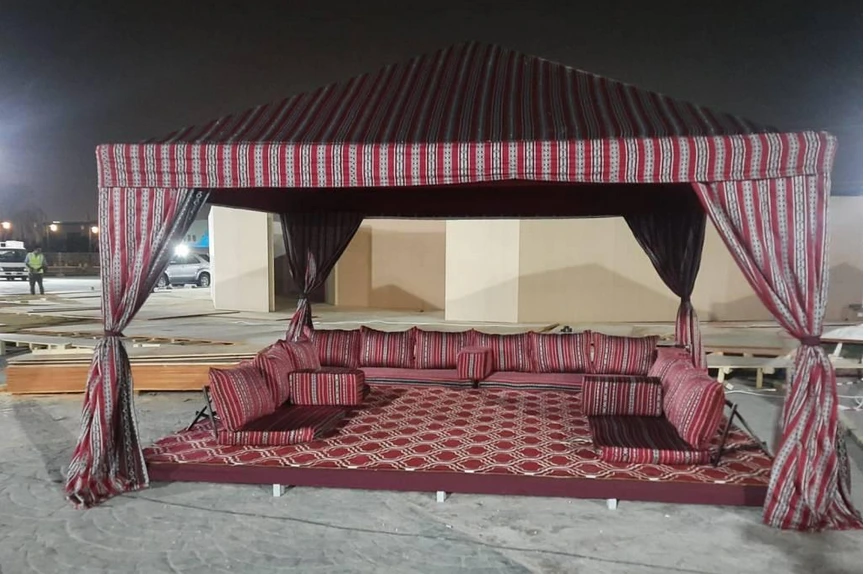
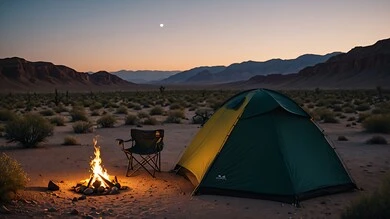
The domed hiking tent designed for temperate European camping is not well suited to UAE desert conditions. It traps heat, offers no outdoor sitting space, and gets uncomfortably hot even in mild winter conditions. The Arabic tent — with its open-sided design, elevated canopy, and woven or breathable fabric — was engineered for desert living. The open face allows evening breezes to move through the shelter, keeping the interior 5 to 8 degrees cooler than the outside ambient temperature when oriented correctly. For a family or group barr trip, an Arabic tent in the 5m x 6m to 6m x 8m range is the right primary shelter.
Tip 8: Orient your tent to catch the evening breeze.
In the UAE from October through April, the prevailing evening breeze comes from the north or northwest. Orient the open face of your Arabic tent toward this direction. The result is a natural airflow through the tent that makes the sitting and dining area comfortable even on warm evenings. Getting this direction wrong — particularly opening the tent toward the afternoon sun in the southwest — turns your shelter into a heat collector.
Tip 9: Use sand stakes, not regular tent pegs.
Standard wire tent pegs pull straight out of soft sand under tension. Wide-blade sand pegs, spiral sand anchors, or long aluminium sand stakes provide the purchase needed to keep an Arabic tent or canopy under tension in sandy terrain. In very soft sand, attach guy ropes to a buried deadman anchor — a filled water bottle or a bag of sand buried horizontally at depth works well.
Tip 10: Set up camp before dark.
Arriving at your UAE campsite with enough daylight to set up the tent, prepare the cooking area, and locate the nearest hazards (soft sand patches, vehicle access points) makes everything safer and easier. Stumbling around a dark campsite with unfamiliar terrain, trying to locate tent poles and stakes by torchlight, is avoidable. Aim to arrive with at least two hours of daylight remaining.
Water and Hydration Tips
Tip 11: Carry more water than you think you need.
The standard calculation for UAE desert camping is 5 litres of drinking water per person per day, plus 2 litres for cooking and 1 to 2 litres for basic hygiene per person per day. For a group of 4 on a two-night trip, that is a minimum of 56 litres — before you add any safety margin. Carry 20 to 30 percent more than your calculation. Water weighs one kilogram per litre, which means a fully loaded 4WD is the right vehicle for the job. Running low on water in a hot desert is a medical emergency in the making.
Tip 12: Pre-cool your water before leaving home.
A quality hard-sided cooler box pre-loaded with 8kg ice blocks and filled with water bottles keeps drinking water cold for 48 to 72 hours. Freeze water bottles at home and pack them alongside fresh ones — they act as ice blocks while providing additional water as they thaw. Cheap coolers with thin walls will not maintain temperature in UAE desert conditions; the investment in a proper cooler pays off immediately.
Tip 13: Do not rely on single-use plastic water bottles for your main supply.
Single-use 500ml bottles create enormous waste at camp and are impractical to pack out responsibly. Use 20-litre water jerry cans for your main water supply. A gravity-fed camp water dispenser connected to a jerry can makes filling cups, washing hands, and cooking water easily accessible without waste.
Food and Cooking Tips
Tip 14: Prepare and portion food at home before leaving.
Marinated meats, pre-measured rice portions, pre-chopped vegetables, and pre-made sauces are all dramatically easier to cook at camp than starting from raw ingredients with limited prep space. Seal portioned ingredients in labelled zip bags. At camp, cooking becomes assembly rather than preparation — which is faster, cleaner, and uses less water for washing up.
Tip 15: Plan your fire correctly — or skip it.
Open fires are culturally central to Gulf camping but carry real risks in dry desert conditions. From June through September, open fires are prohibited in most UAE desert areas. In the camping season, check local emirate guidelines before lighting a fire. When fires are permitted, use a purpose-built fire pit or ring, keep the fire small and controlled, never leave it unattended, and have water ready to extinguish it fully before sleeping or leaving camp. Gas burners are always a safe alternative for cooking.
Tip 16: Store food in sealed hard containers, not bags.
UAE desert insects — flies, ants, and beetles — will locate uncovered food within minutes of exposure. Store all food in sealed hard-sided containers or sealed zip bags inside coolers. Hang anything attracting insects away from the tent and sleeping area. This applies to cooking waste and rubbish as well — a sealed rubbish bag kept away from camp prevents most insect problems.
Vehicle and Driving Tips
Tip 17: Check your 4WD before leaving home.
A vehicle breakdown in a remote UAE desert location is a situation that deserves prevention, not recovery. Before any serious barr trip, check: tyre pressure and condition (including the spare), engine oil and coolant levels, fuel level (fill up before leaving the last petrol station — distances in Liwa and the Hajar mountains are long), battery condition, and that the 4WD low-range selector engages and disengages correctly. A basic vehicle check takes 15 minutes and costs nothing.
Tip 18: Deflate your tyres before driving on soft sand.
Driving on soft sand dunes with standard tyre pressure — typically 32 to 35 PSI for a loaded 4WD — is the most common cause of vehicles getting stuck in UAE desert. Reducing tyre pressure to 15 to 18 PSI increases the contact patch between tyre and sand significantly, allowing the vehicle to float across soft surfaces rather than dig in. Carry a portable compressor to re-inflate tyres before returning to paved road. Never drive at low tyre pressure on tarmac at speed.
Tip 19: Carry sand recovery boards on every trip with dune driving.
Two 1.2-metre sand ladders or recovery boards are the most-used recovery tool in UAE desert driving. When wheels sink into soft sand, placing boards under the tyres and driving slowly forward restores traction without requiring another vehicle. Practise using them before your first serious dune drive — deployment under pressure should take under three minutes.
Tip 20: Never drive alone on steep dunes without knowing the other side.
Every year, vehicles roll in the UAE desert because drivers committed to a steep dune face without knowing whether the other side was a gentle slope or a near-vertical drop. Before driving over an unfamiliar dune crest, get out and walk to the top to check the descent angle and landing. If the other side is steep or soft at the base, find a different route. No photography opportunity or arrival shortcut is worth a rollover.
Safety Tips
Tip 21: Know the signs of heat exhaustion and heat stroke.
Even in the UAE camping season, exertion in direct sun — setting up camp, collecting firewood, playing with children — causes heat exhaustion faster than most people expect. Signs of heat exhaustion: heavy sweating, weakness, cold or pale skin, fast or weak pulse, nausea. Move the person to shade, provide cool water, and apply damp cloths to skin. Heat stroke — the dangerous progression — is characterised by a body temperature above 40 degrees, hot and red skin, no sweating, and confusion. Heat stroke requires immediate emergency medical attention. Call 998 (UAE ambulance) and evacuate.
Tip 22: Check for scorpions before putting on shoes and sitting on rocks.
UAE desert scorpions are active at night and shelter in shoes, clothing left on the ground, and under rocks during the day. Shake shoes and clothing out before putting them on. Do not sit or place hands on rocks without checking first. Most UAE scorpion stings cause intense local pain and swelling but are not life-threatening for healthy adults. Keep antihistamine in your first aid kit and know the location of the nearest hospital for your campsite before you leave home.
Tip 23: Keep a fully charged power bank and know the emergency numbers.
UAE emergency numbers: Police 999, Ambulance 998, Civil Defence 997. For remote desert rescue, the UAE has helicopter rescue capability. A charged power bank keeps your phone usable through an overnight trip and into an unexpected delay. A basic satellite communicator — sold at outdoor equipment retailers in the UAE — provides emergency messaging when mobile coverage is absent.
Camp Etiquette and Leave No Trace
Tip 24: Pack out everything you packed in.
The condition of UAE desert camping areas has deteriorated in recent years as camping has grown in popularity. The problem is simple: many people leave rubbish behind. Bring a dedicated rubbish bag for your camp and fill it completely. This includes food waste, ash from fires, cigarette ends, and any packaging. Municipalities in Abu Dhabi and Dubai enforce littering fines in desert areas, but the stronger motivation is the basic responsibility to keep a shared natural environment usable for everyone who follows you.
Tip 25: Respect the distance between camps.
The informal standard at popular UAE camping spots like Al Qudra and the open desert south of Dubai is a 50-metre minimum gap between neighbouring camp setups. Beyond distance, position the closed side of your tent toward nearby camps rather than the open face — this provides privacy for both groups. Loud music late at night in a shared camping area is considered poor manners in UAE camping culture. Sound carries in the desert and the night quiet is part of what people are there for.
Tips Specific to First-Time Barr Campers
If this is your first UAE barr camping trip, three specific adjustments will make the experience significantly better than a typical first-time attempt:
- Start with a managed or accessible site: Al Qudra, Mleiha, or Hatta before Liwa. The terrain is forgiving and facilities or help are nearby if needed.
- Go with someone who has done it before: One experienced camper in your group covers most of the knowledge gaps that cause first-timers to struggle — tent setup, fire management, vehicle positioning, and the dozen small decisions that experienced barr campers make automatically.
- Overpack on your first trip, then refine: It is better to carry things you did not need than to discover a missing item 60 kilometres from the nearest shop. After your first trip, you will know exactly what to cut on the next one.
Frequently Asked Questions
What is the best time of year for camping in the UAE desert?
November through February is the peak UAE camping season. Daytime temperatures sit between 20 and 28 degrees; overnight drops to 12 to 18 degrees are comfortable with a light sleeping bag or blanket. October and March are good shoulder months with warm evenings. April through September is manageable only for experienced campers using specific strategies — early morning and evening windows, elevated terrain, or air-conditioned sleeping arrangements.
Do I need a 4WD for camping in the UAE?
For managed sites with paved or graded gravel access — Al Qudra, Mleiha managed zone, Hatta — a regular SUV is sufficient. For any trip involving dune driving, remote mountain tracks, or remote desert access, a proper 4WD with low-range capability, good ground clearance, and sand recovery equipment is required. Attempting soft-sand dune crossings in a 2WD vehicle causes the majority of UAE desert vehicle rescues.
Where can I buy or hire an Arabic tent for camping in UAE?
Arab Muzalat supplies Arabic tents in traditional and modern steel-frame styles across multiple sizes — from a compact 3m x 4m shelter for a small family to a 10m x 15m tent for large group camps. Delivery is available across Dubai, Abu Dhabi, Sharjah, and the Northern Emirates. Contact us for sizing advice and pricing for your specific camping setup.
Is it safe to camp in the UAE desert alone?
Solo camping in managed, accessible sites — Al Qudra, Hatta — is reasonably safe provided you tell someone your location and expected return time, carry sufficient water and food, and have a way to call for help. Solo camping in remote desert — Liwa, deep Hajar tracks, Empty Quarter access routes — is not recommended. The risk profile is too high for a single person without a second vehicle for recovery or help.
What are the most common mistakes first-time UAE desert campers make?
The five most common mistakes: arriving without enough water; not checking weather and wind forecasts (sandstorms move fast in the UAE desert); underestimating how early the sun rises and heats up; not packing sand recovery equipment for dune terrain; and leaving rubbish. All five are simple to avoid with a proper pre-trip checklist.
Arab Muzalat provides Arabic tents for UAE barr camping in all sizes and styles — traditional goat-hair fabric and modern powder-coated steel frame options available. Contact us for sizes, pricing, and UAE-wide delivery.