A villa owner installing a two-bay car shade and a facility manager specifying shade for a 200-space compound car park are solving the same problem — vehicle protection from UAE heat — but the scale, structural approach, approval process, and total investment are completely different.
This guide is for commercial and semi-commercial buyers: building managers, facilities managers, property developers, hotel operations teams, hospital administration, and community management companies dealing with multi-bay car shade projects in the UAE.
Who Needs Commercial Car Shades in UAE
The following property types regularly specify commercial-scale car shade installations:
- Residential compounds and gated communities: Outdoor visitor and resident parking areas that are not covered by the building structure. Community management companies are responsible for installation and maintenance.
- Office and commercial buildings: Staff and visitor surface parking lots. Shaded parking is increasingly listed as a tenant requirement in commercial leasing, particularly for buildings pursuing LEED or Estidama certification.
- Hotels and hospitality properties: Guest car parks, valet drop-off areas, and staff parking. Hotel operators in UAE typically specify polycarbonate or high-quality HDPE for guest-facing areas and standard HDPE for staff lots.
- Hospitals and healthcare facilities: Patient, visitor, and staff parking. Shaded parking reduces ambulance cabin temperatures after vehicle sits in the sun during a shift, which matters for temperature-sensitive medical equipment stored in vehicles.
- Petrol stations and service centres: Forecourt shade and service bay canopies. Structural requirements are higher due to vehicle height variation (commercial trucks, SUVs with roof racks).
- Schools and universities: Parent pick-up zones, staff parking, and school bus waiting areas. Typically specify breathable HDPE at maximum shade factor to reduce heat stress on children waiting outdoors.
- Logistics and industrial yards: Equipment and vehicle storage. Often use simple H-frame structures with heavy-duty HDPE or metal panels depending on the equipment being sheltered.
How Commercial Car Shade Design Differs from Residential
Multi-Bay Row Systems
Residential installations cover one or two bays. Commercial installations cover rows of 10, 20, 50, or more bays. The structural logic shifts at scale:
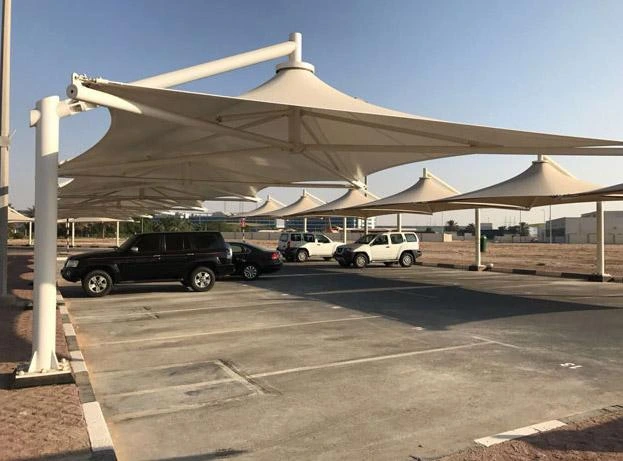
- Single-row systems: A line of bays with columns on both sides and canopy between. Columns are spaced every 3 to 6 m along the row, reducing the number of footings compared to individual bay structures.
- Double-row back-to-back systems: Two rows of parking sharing a central column line. The most material-efficient configuration for wide open lots. One column serves four parking spaces — two facing each direction. Common in UAE compound and hotel car parks.
- Modular expansion systems: Designed so that additional bays can be added to either end of an existing row without major structural change. Used by developers who want to phase installation and expand as occupancy increases.
Clearance Height for Commercial Vehicles
Residential car shades typically clear at 2.2 m — sufficient for standard passenger vehicles. Commercial installations must accommodate:
- Full-size SUVs and pickup trucks: 2.0–2.2 m body height, roof racks add 0.3–0.5 m
- Light commercial vans: 2.0–2.8 m including roof equipment
- Service and delivery trucks: 3.0–4.5 m depending on type
- Emergency vehicles: 2.8–3.5 m including light bars and roof equipment
Commercial specifications typically set clearance at a minimum of 2.8 m for general parking and 3.5 m or higher for mixed-use lots that include service vehicles. Getting this wrong means the shade cannot serve the full range of vehicles on site.
Wind Load Engineering for Large Spans
A single-bay shade over a 3 m × 6 m footprint has a modest wind load. A 200-bay shade installation over 6,000 m² is a major structure. UAE wind load standards (based on ASCE 7 and local municipality amendments) require formal engineering calculations for any shade structure exceeding defined size thresholds. Commercial shade projects require:
- Wind load calculation by a UAE-registered structural engineer
- Stamped structural drawings submitted with the permit application
- Column sizing and footing depth calculated for the specific site wind exposure category
- Connection details for beam-to-column and column-to-footing joints
This is not optional for commercial installations. An under-engineered commercial shade is a liability for the property owner if it fails and damages vehicles or injures people.
Foundation Types for Commercial UAE Car Shade Projects
Poured Concrete Footings (New Construction or Open Ground)
The standard for new commercial car park shade installations on open ground: excavate to the specified depth (typically 800 mm to 1,200 mm for commercial columns), install a steel reinforcement cage, and pour a concrete footing sized to the column load and soil bearing capacity. This method gives the most reliable long-term performance and is used on all new-build commercial projects in Abu Dhabi and most of Sharjah.
Core-Drilled Footings (Existing Paved Car Parks)
For shade retrofits over existing asphalt or concrete surfaces, core drilling through the existing pavement is the standard method. Holes are drilled at column positions, the column base is inserted, and non-shrink grout fills the annular gap. The advantage is minimal disruption to the existing surface. The challenge is avoiding underground services — a full utilities survey is mandatory before drilling in a commercial car park.
Surface-Mounted Base Plates (Podium Decks and Waterproofed Slabs)
Podium car parks and rooftop parking decks have waterproofing membranes that cannot be penetrated. Chemical anchor bolts bond a steel base plate to the structural slab surface. The base plate is welded or bolted to the column base. This method requires the slab to have sufficient structural capacity for the imposed column load — a structural assessment of the existing slab is a prerequisite.
The Permit Process for Commercial Car Shades in UAE
Commercial shade installations follow a stricter approval path than residential ones.
Required Documentation
- Architectural drawing showing the shade layout on a site plan
- Structural drawings signed by a UAE-registered structural engineer
- Material specifications for canopy fabric, frame steel grade, and coating system
- NOC from utilities authority confirming no underground services at footing locations
- For properties in free zones: additional approval from the relevant free zone authority
Typical Timeline
Commercial car shade permit applications in Dubai typically take 4 to 8 weeks from submission to approval. Abu Dhabi NOC processes vary from 3 to 10 weeks. Projects in Northern Emirates are generally faster — 2 to 6 weeks. Build the permit timeline into your project schedule before committing to installation dates with tenants or building management.
Commercial Car Shade Canopy Options
HDPE Shade Cloth (90% shade factor)
The most widely used option for commercial UAE installations. In a commercial environment, choose 90% shade factor (versus the 70–80% common in residential) to maximise UV blocking in high-use areas. Commercial-grade HDPE has a heavier GSM (grams per square metre) than residential fabric — look for 330 GSM or higher for installations that will be under daily vehicle traffic load and cleaning regimes.
Polycarbonate Panels
Used in hotel valet areas, luxury compound guest parking, and retail car parks where the visual quality of the structure matters commercially. Twin-wall polycarbonate provides thermal insulation properties that reduce the heat gain under the canopy compared to standard single-layer polycarbonate. Cost is two to three times higher than HDPE per square metre but lifespan is 12 to 15 years versus 5 to 7 for fabric.
Metal Deck (Aluminium or Steel Composite Panels)
Used for covered car parks where full weather protection is required and visual quality is secondary (logistics yards, industrial sites, back-of-house hotel parking). Provides rain, hail, and full UV protection. Heaviest structure type — requires the most robust foundation and frame engineering.
Total Cost for Commercial Car Shade Projects in UAE
Commercial projects are typically priced per bay or per square metre of covered area, not as individual units.
SpecificationCost per bay (approx)Cost per m² (approx) Standard HDPE, double-row back-to-backAED 2,500–4,500AED 130–220 High-spec HDPE, single-row with arch frameAED 4,000–7,000AED 200–350 Polycarbonate, hotel-gradeAED 8,000–15,000AED 400–750 Metal deck, industrialAED 6,000–12,000AED 300–600 Add permit and engineering fees (typically AED 15,000–40,000 for a full commercial project), utilities survey cost, and any site preparation work (clearing, levelling, existing surface removal). For large projects over 100 bays, obtain at least three itemised quotes — the per-bay price gap between suppliers at this scale can be significant.
Maintenance Programmes for Commercial Installations
Commercial car shade installations require a scheduled maintenance programme, not ad-hoc repairs. For a facility manager, this means establishing a service contract that covers:
- Bi-annual canopy inspection and cleaning: Before summer (April) and after shamal season (October). Commercial car parks accumulate bird droppings, sand, and chemical residue from vehicles that degrades HDPE faster than residential use.
- Annual structural inspection: All column bases, beam connections, and anchor bolts checked for corrosion or movement. Report with photographic evidence for insurance and warranty records.
- Canopy panel replacement programme: For large installations, replace canopy panels in sections on a rolling 5–7 year cycle rather than replacing all at once. This spreads capital expenditure and avoids a situation where the entire installation reaches end of life simultaneously.
- Storm response protocol: A clear post-storm inspection procedure with a defined response time — typically within 24 hours of any significant weather event — to identify and address damage before it spreads.
Frequently Asked Questions
What is the minimum number of bays for a commercial car shade project?
There is no formal minimum. Practically, most commercial shade suppliers begin applying commercial pricing and engineering at around 10 bays. Below that, the project is typically handled under residential or semi-residential terms.
Does a commercial car shade project require a structural engineer in UAE?
Yes, for any permanent shade structure in a commercial context. The structural engineer signs the drawings submitted with the building permit application. Some smaller projects in Northern Emirates may be processed without full engineering drawings, but this creates liability exposure for the property owner.
How long does a 50-bay commercial car shade installation take?
After permit approval, a 50-bay installation on open ground with standard foundation conditions takes approximately 7 to 14 working days for a professional installation crew. Projects involving complex foundation conditions, podium slabs, or phased installation around active car park operations take longer.
Can we add solar panels to a commercial car shade structure in UAE?
Yes, and this is increasingly common in UAE commercial projects. The shade structure frame is engineered to carry the additional dead load of solar panels, and the panels replace or sit above the standard canopy. This requires a separate solar installation permit from DEWA, ADDC, or the relevant utility authority. The combined carport-solar installation qualifies for UAE green building certification points.
What warranty should we expect on a commercial car shade in UAE?
Industry-standard warranty for commercial UAE car shade installations: 5 years on the steel frame against structural defects, 2 years on the canopy fabric against manufacturing defects, and 1 year on motorisation components (where applicable). Extended warranties are available from established suppliers — ask for the warranty terms in writing before signing any contract.
Contact Arab Muzalat for commercial car shade projects across Dubai, Abu Dhabi, Sharjah, and the Northern Emirates — supply, engineering, permit handling, installation, and maintenance service for multi-bay and large-scale projects.