The Interior Is the Experience
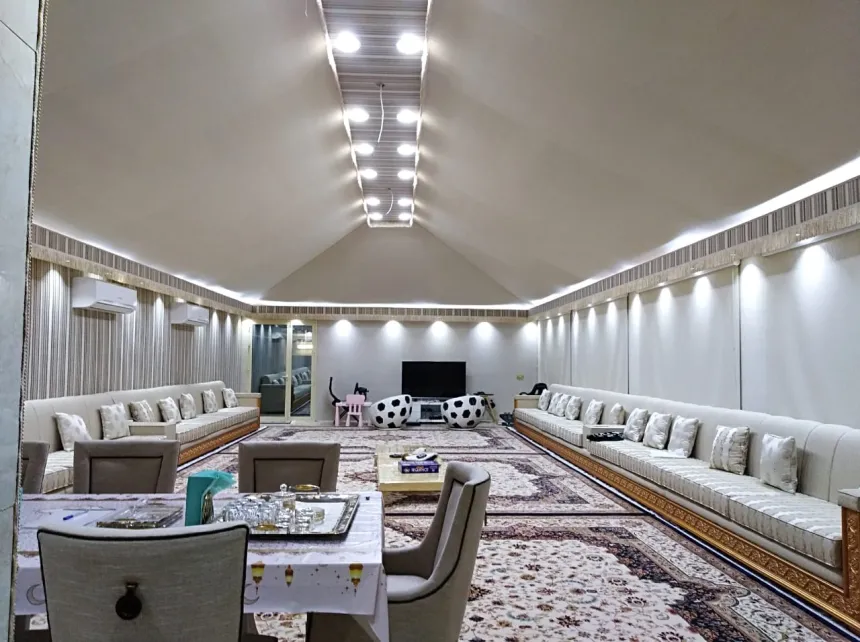
The exterior of an Arabic tent — its shape, colour and structure — draws the eye. But the interior is what guests remember. In a well-decorated Arabic tent, every element works together: the ceiling draping catches the light from the lanterns below, the rug absorbs sound and grounds the space, and the arrangement of cushions and low tables signals how the host wants guests to move and gather.
This guide breaks down the seven key elements of Arabic tent decoration and explains how to combine them effectively for different settings — from a private family majlis to a large Ramadan or wedding installation.
1. Ceiling Draping
The most immediately impactful interior element in any Arabic tent is what happens above eye level. The two dominant styles are:
- Star-draped ceiling: All fabric panels gather at a central point and radiate outward like a sunburst. Works best in square and octagonal tents. Creates a dramatic focal point, especially when a chandelier hangs from the centre.
- Valance and swag ceiling: Long fabric panels are gathered at the ridge and fall in soft swags along the tent's length. Works in rectangular tents of any scale, more forgiving of tent irregularities, and easy to refresh between events by swapping swag colours.
Ivory and white are the most versatile fabric choices and reflect light well. Champagne and gold tones warm up a space for formal events. Deep burgundy or navy create drama for heritage-themed setups.
2. Lighting
Lighting transforms a tent from a structure into an atmosphere. The layers used in a well-lit Arabic tent:
- Chandeliers (ثريا): The centrepiece — one large chandelier or a cluster of smaller ones hung from the ridge pole. Crystal chandeliers suit formal events. Moroccan-style brass lanterns suit desert camp and heritage aesthetics.
- Fairy lights and Edison strings: Woven through the ceiling draping or strung across the interior in parallel lines, creating a warm intimate glow at minimal cost.
- Floor lanterns: Moroccan-style punched metal or coloured glass lanterns at the entrance, along corridors, and at the corners of seating areas.
- Uplighting: Coloured LED par cans or tube lights directed upward along the tent poles or at the exterior. Changes the entire mood of the space at a single switch.
3. Floor Covering
The floor of an Arabic tent is rarely left bare. Options in order of cost and formality:
- Kilim and Persian area rugs: Layered over a hard subfloor or directly on compact soil. The most authentically Arabic choice, with rugs 3×5m to 4×6m standard for seating sections.
- Wall-to-wall carpet: Practical for large event tents. Applied over EVA foam underlay to soften the floor. Available in faux-Persian and Arabic geometric patterns.
- Wooden or composite decking: Used for glamping-style Arabic tents and permanent majlis structures. Raises the floor above ground level, keeps the space dry, and is easy to maintain.
4. Arabic Seating Arrangements
Traditional Arabic tent seating is low — cushions and bolsters on the floor, sometimes on a slightly raised wooden platform. Modern setups often combine this with Western chair-and-table seating to accommodate all guests.
Three configurations work well:
- Perimeter jalsa: Cushioned seating along all four walls, with a clear central space for coffee service and conversation. Classic for family gatherings and Ramadan tents.
- U-shape arrangement: Cushion sections along three sides with the fourth open, typically facing the entrance. Allows a host to address the group naturally.
- Mixed jalsa and banquet: Low seating at the perimeter for informal mingling and table-chair clusters at the centre for dining. Works well for wedding receptions with multiple function zones.
5. Textiles and Cushions
Textiles carry the cultural coding of the Arabic tent. Key pieces:
- Kilim cushion covers: Geometric patterns in earthy tones — terracotta, rust, olive, cream. Mix 60cm floor cushions, 40cm back cushions, and cylindrical bolsters.
- Embroidered throw blankets: Placed loosely over seating for cooler evenings. Gold and maroon embroidery on cream or black ground is the most classic combination.
- Table runners: A woven or embroidered runner in an Arabic pattern ties banquet table settings to the tent's overall aesthetic.
6. Decorative Details That Elevate the Space
Four details consistently lift an Arabic tent from standard to memorable:
- Arabic coffee and dates station: A dedicated corner with a dallah, serving trays, stacked cups, and a bowl of dates. Functional, culturally resonant, and a natural photo spot.
- Incense burner (mabkhara): A traditional wooden or metal mabkhara at the entrance or seating centre. The visual of rising oud or bakhour smoke is as impactful as the scent itself.
- Calligraphy panels: Framed Arabic calligraphy or vinyl calligraphy decals on the tent poles. Verses about hospitality or welcome personalise the space and photograph beautifully.
- Decorated entrance arch: A tall arch with tassels, flowers, or lanterns marks the threshold and sets expectations before guests enter.
7. Climate Control Integration
No decoration succeeds if the tent is uncomfortable. In UAE conditions, climate control is essential for events between April and October. Cooling integrates most effectively when planned from the start:
- Evaporative cooler ducts can be hidden under the floor edge or behind rear seating panels.
- AC unit outlet vents can be masked with decorative grille panels to match the tent's aesthetic.
- A professional tent decorator will route cabling and ducting invisibly — ask to see photos of their climate-control installations before agreeing to a package.
What colours work best for Arabic tent decoration?
The most effective Arabic tent colour schemes use a warm neutral base — ivory, cream, sand or champagne — with two to three accent colours layered in. Classic pairings: burgundy and gold; cobalt and cream; terracotta and olive. Avoid more than three accent colours — the layered textiles and lighting already provide visual complexity.
How much does Arabic tent decoration cost in the UAE?
A basic Arabic tent decoration package — ceiling draping, floor covering, simple lighting and cushion seating — starts at around AED 4,000–7,000 for a 6×10m tent. A mid-range package with chandeliers, layered textiles, lanterns and a coffee station runs AED 10,000–20,000. Full luxury setups for large wedding or corporate tents with custom fabrication, premium furnishings and complex lighting design reach AED 40,000–100,000+.
Can I decorate an Arabic tent myself?
Basic decoration — cushions, lanterns, rugs and string lights — is achievable as a DIY project. The elements that genuinely benefit from professional help are ceiling draping (working at height, achieving even tension, hiding attachment points) and electrical lighting (safe cable runs, correct lamp holders, generator or mains connection). If decorating for a public or commercial event, a professionally installed lighting rig is safer and typically required by venue insurers.
Arab Muzalat: Decoration Services for Arabic Tents
Arab Muzalat's decoration team has fitted out Arabic tents for private families, government events, hotel Ramadan zones, and large-scale weddings across the UAE. We supply the tent structure and the complete interior — brief us on your vision, guest count and budget, and we handle the rest.
Request a decoration consultation by calling +971 58 590 5666 or visit our showroom to browse our fabric library, cushion collections and lighting catalogue.