What Is Arabic Interior Design Style
Arabic interior design style is not a single fixed aesthetic. It is a design philosophy rooted in the Islamic concept of karam — generosity toward the guest. Every element of a traditional Arabic interior is arranged to welcome, to comfort and to impress the visitor, while simultaneously protecting the privacy of the household. This dual purpose shapes everything from the layout of rooms to the choice of textiles and scent.
At its core, Arabic interior design operates on three principles: spatial layering, sensory richness and symbolic ornamentation. Rooms are not minimal. They are intentionally layered — cushion over carpet, lantern over panel, arch over arch — because abundance signals hospitality. Yet within that richness, there is a rigorous logic. Public spaces (the majlis, the reception hall) are grand and ornamental. Private spaces (sleeping quarters, family areas) are quieter and more personal. The separation of these zones is a structural feature of Arabic architecture, not a stylistic afterthought.
In the UAE context, this translates into tent interiors, majlis spaces and outdoor pavilions that carry the same layering logic indoors but expressed through temporary or semi-permanent structures. Arab Muzalat builds tent and shade systems that apply this philosophy from the ground up.
7 Defining Elements of Arabic Interior Design Style
1. Mashrabiya Screens
The mashrabiya is perhaps the most recognisable element of Arabic interior design style. Originally a projecting oriel window enclosed with carved wooden lattice, it served three functions in traditional Arabic architecture: light filtration, airflow regulation and visual privacy. The lattice casts shifting geometric shadow patterns across floors and walls throughout the day — a living decoration that changes with the sun.
In modern UAE homes and tents, the mashrabiya has evolved. Laser-cut steel or aluminium panels reproduce the intricate geometry of the original carved wood at a fraction of the cost and with greater durability. These panels work as partition walls, tent side panels, feature headboards, room dividers and ceiling inserts. The pattern play they create on interior surfaces is immediate and dramatic without requiring any additional decorative effort.
Arab Muzalat fabricates bespoke laser-cut mashrabiya panels in-house. They are installed as tent walls, pergola infill panels and shade screen elements, bringing authentic Arabic pattern into temporary outdoor structures across the UAE.
How to incorporate in a UAE home: Use a full-height mashrabiya panel to divide a majlis from a corridor. Install a backlit version as a feature wall in a dining area. Use smaller panels as window inserts to replace plain glass in a traditional Arabic house design.
2. Pointed Arches and Iwan Portals
The pointed arch is the signature silhouette of Islamic architecture. Unlike the rounded Roman arch, the Islamic pointed arch draws the eye upward and creates a sense of elevation and spiritual aspiration. It appears in doorways, window frames, niches, mirror frames and — in tent design — entry portals and interior ceiling ribs.
The iwan is a formal vaulted space, open on one side, framed by a pointed arch. In traditional Arabic house design, the iwan served as a transitional space between the external courtyard and the private interior. In contemporary UAE tent and pavilion design, the iwan arch is used as the entry statement — a grand portal that signals arrival and sets the tone for what lies within.
Application in tents and outdoor structures: Tent entry portals fabricated with a steel arch frame, clad in fabric or GRC panels, create the iwan effect for events and permanent garden structures. Internal tent ribs shaped as pointed arches add vertical drama to the ceiling line.
3. Muqarnas Ceilings
Muqarnas — sometimes called honeycomb or stalactite vaulting — is one of the most technically complex achievements of classical Islamic architecture. The muqarnas ceiling is composed of stacked niche-like elements that cascade downward in successive tiers, creating a three-dimensional surface of extraordinary visual complexity. At its finest, as seen in the Alhambra or the Sheikh Zayed Grand Mosque, it appears to dissolve the ceiling into a field of crystalline geometry.
In Arabic interior decor today, muqarnas ceilings are replicated using lightweight GRC (glass-reinforced concrete) panels or high-density polyurethane foam mouldings. These materials allow the visual effect of the muqarnas ceiling to be achieved without the structural weight of traditional stucco. For tent and majlis interiors, GRC muqarnas panels are suspended from internal steel frames to create the appearance of a vaulted ceiling within a fabric envelope.
Arabic ceiling design for hall: A central muqarnas dome medallion surrounded by a geometric plasterwork border is the standard approach for high-end Arabic reception halls in the UAE. For tents, a fabric liner printed with a muqarnas pattern achieves a similar visual effect at lower cost.
4. Arabic Calligraphy as Art
Calligraphy holds a unique position in Arabic interior design style. Because Islamic tradition historically discouraged figurative representation in religious spaces, the written word — particularly Quranic verses and classical Arabic poetry — became the primary vehicle for figurative art. Arabic calligraphy developed into a sophisticated art form with distinct scripts: Kufic, Naskh, Thuluth, Diwani and others, each with its own character and appropriate context.
In interior design, calligraphy appears as large-scale wall panels (carved stone, laser-cut metal, cast plaster), as framed works of art, as fabric embroidery on cushions and curtains, and as three-dimensional sculptural pieces. A single well-executed calligraphy piece can serve as the anchor of an entire room, replacing multiple smaller decorative elements.
Selection guidance: For a majlis or reception space, a verse from the Quran rendered in Thuluth script on a carved panel above the main seating area is the classic choice. For a tent or event space, backlit laser-cut calligraphy panels in stainless steel or brass-effect aluminium deliver impact without permanence.
5. Geometric Tile, Zellige and Inlay
Geometric pattern is fundamental to Arabic aesthetic philosophy. Where other traditions use floral or figurative motifs as primary decoration, Arabic interior design elevates geometry to an art form. The interlocking star-and-polygon patterns found on floors, walls and ceilings are not merely decorative — they carry mathematical and cosmological significance.
Zellige tile — hand-cut terracotta glazed in vivid colours and assembled into geometric mosaic — originated in Morocco but is used across the Arab world and is widely available in the UAE. It appears on floors, as backsplash panels, as table tops and as feature wall sections. Beyond zellige, geometric inlay in marble (pietra dura) and wood marquetry are used on surfaces throughout a traditional Arabic house design.
UAE sourcing: Zellige tiles and geometric marble inlay are available through suppliers in Dubai Design District and from specialist importers in Jumeirah. For tent flooring, geometric pattern vinyl or rubber tiles provide a practical and cost-effective alternative that captures the Arabic aesthetic without the fragility of ceramic on temporary structures.
6. Rich Textile Layering
Textiles are the most immediate sensory signature of Arabic interior decor. The traditional Arabic interior does not treat furniture as the primary object — it treats the textile layer as the room itself. Carpets, floor cushions, bolster pillows, wall hangings, canopy drapes and curtains collectively define the space more than any fixed architectural element.
Key textiles in Gulf Arabic interior design include:
- Velvet: Deep-pile velvet in jewel tones (cobalt, burgundy, forest green) for majlis seating upholstery and floor cushions
- Silk brocade: Woven metallic-thread brocade for cushion covers, curtain panels and bed canopies
- Sadu weave: Traditional Bedouin flat-weave textile in geometric patterns — the authentic textile heritage of the Arabian Peninsula, used for floor runners, cushion covers and wall hangings
- Tasselled and fringed pieces: Tassels and fringe on cushions, curtain tie-backs and carpet borders add movement and tactile richness
- Embroidery: Gold-thread embroidery on curtains and cushion panels, often incorporating geometric or calligraphic motifs
Layering without overwhelming: Start with a neutral base (stone, cream or camel walls and floor), then introduce a large-format geometric carpet in warm tones. Layer cushions in two or three complementary jewel tones. Add one textured throw in Sadu weave. Finish with curtain panels in a silk or velvet that echoes the dominant cushion colour. The result is rich without being chaotic because the palette is controlled and the base is calm.
7. Scent as a Design Element: Oud, Amber and Frankincense
Arabic interior design style is as much about scent as it is about visual appearance. The use of bakhoor (scented wood chips soaked in fragrant oils, burned over charcoal) is a hospitality ritual in Gulf homes and tents. The bakhoor burner — the mabkhara — is itself a decorative object, often crafted in ceramic, brass or silver, and placed prominently in the majlis or reception area.
The primary scent materials of Gulf Arabic interiors are oud (agarwood resin, one of the most expensive raw materials in the world), amber (a warm, musky-sweet resin blend) and frankincense (luban — the aromatic resin burned in religious and domestic contexts across the Arab world). These are not air fresheners. They are architectural elements that define the atmosphere of the space as surely as the lighting or the textiles.
Design integration: Place a mabkhara on a carved wooden stand at the entrance of a majlis tent. Use frankincense resin in a simple burner at a garden pavilion entrance. Select oud-based room sprays for large tent spaces where charcoal burning is impractical. The scent layer is the final design touch that makes an Arabic interior feel complete.
Arabic Colour Theory: Earth Tones, Jewel Accents and Gold
The colour palette of Arabic interior design style is built on a three-tier structure that produces spaces that feel simultaneously grounded and opulent.
TierRoleColoursBase layerWalls, large floor areas, structural elementsCamel, sand, terracotta, ochre, warm white, raw linenAccent layerUpholstery, curtains, cushions, tilesDeep cobalt blue, emerald green, burgundy, burnt sienna, plumUnifying threadMetalwork, lighting, trim, embroidery, hardwareGold (warm), aged brass, antique bronze The earth tone base draws from the desert landscape of the Arabian Peninsula. These colours do not compete with the decorative layers above them — they provide a warm, neutral field that makes the jewel tone accents appear more vivid than they would against a cool or white background. Gold is not used as a primary colour but as the thread that connects all other elements: the brass lantern, the gold-thread embroidery, the gilded mirror frame, the metalwork screen.
A common mistake in attempting Arabic interior decor is to use gold as the dominant colour. Authentic Arabic interiors use gold sparingly as a connector, not as a statement. The statement is made by the richness of the textiles and the intricacy of the pattern work.
Gulf Arabic vs Moroccan vs Levantine vs Egyptian: Which Style Dominates UAE Design
The Arab world spans a vast geography and several distinct design traditions. Understanding the differences helps in identifying what is authentic to the UAE context and what is borrowed from elsewhere.
- Gulf Arabic (Arabian Peninsula style): The dominant influence in UAE residential and tent design. Characterised by open, generous spaces, deep-pile seating, date-palm and geometric motifs, Sadu weave textiles, subdued earth tones with jewel accents, and a strong emphasis on the majlis as the primary social space. Tent and outdoor structure design in the UAE is almost entirely Gulf Arabic in character.
- Moroccan: Recognisable by zellige tilework, riad courtyard layouts, intricate plasterwork (tadelakt), colourful painted wood (painted cedar ceilings) and arched niches. Moroccan elements — particularly zellige and the arched alcove — are frequently incorporated into UAE interiors and tent designs as accent features, but rarely as the primary stylistic language.
- Levantine (Syrian, Lebanese, Jordanian): Characterised by Damascene inlay work (mother-of-pearl and geometric wood marquetry), Ottoman-influenced textiles, floral pattern integration alongside geometric work, and a cooler, more restrained palette. Levantine furniture — particularly Damascene screens and inlaid tables — is popular in UAE interior markets.
- Egyptian: Strong Pharaonic heritage layered with Islamic ornament. Mashrabiya screens originated in Egypt and remain a defining feature. Egyptian interiors tend toward heavier, darker wood and more structured formality in arrangement.
In UAE design practice, Gulf Arabic style is the foundation, with Moroccan and Levantine elements incorporated as accent features. A UAE tent or majlis will be Gulf Arabic in layout and textile approach but may feature Moroccan zellige on the floor, a Levantine inlaid coffee table and an Egyptian mashrabiya screen. This layered eclecticism within the Arabic tradition is itself authentic to the cosmopolitan character of UAE design culture.
Applying Arabic Interior Design Style to Tents and Outdoor Structures in the UAE
The tent — from the Bedouin bayt al-sha'ar to the modern event marquee — is the original Arabic interior design challenge. Transforming a temporary structure into a space that feels genuinely Arabic requires attention to the same elements that define a permanent interior, applied within the constraints of a fabric envelope.
Pergola and Arisha: Arabic Interior Treatment
The arisha is the traditional UAE palm-frond shade structure. Its modern equivalent — a steel pergola with fabric or slatted shade cover — is the most common outdoor structure in UAE residential properties. To apply Arabic interior design style to a pergola or arisha space:
- Install laser-cut mashrabiya panels as side infill walls on one or two sides, creating privacy and pattern shadow play
- Use a fabric swag ceiling in a warm tone (cream, camel or deep gold) to soften the structural frame and create enclosure
- Hang Moroccan-style lanterns at varying heights from the overhead frame for layered lighting
- Lay a geometric pattern outdoor carpet or interlocking rubber tiles in a zellige-inspired pattern on the floor
- Add bolster cushions in Sadu-patterned fabric to built-in bench seating or low furniture
Majlis Tent: Full Arabic Interior Treatment
The majlis tent is the most complete expression of Arabic interior design style in a temporary structure. A properly fitted majlis tent includes:
- Floor treatment: Fitted carpet or geometric tile effect vinyl, possibly with a large central medallion carpet over the base floor
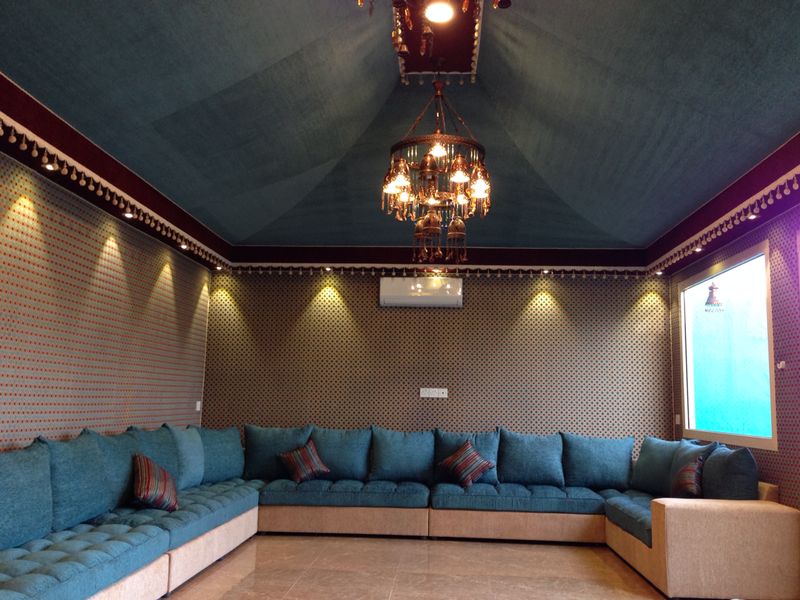
- Tiered seating: Low-profile L-shaped or U-shaped seating units upholstered in velvet, with bolster back cushions and floor scatter cushions creating the tiered layering of a traditional majlis
- Ceiling liner: A fitted fabric ceiling liner, either flat or draped, in a complementary tone to the seating fabric. GRC muqarnas panels or a printed muqarnas-pattern liner can be applied to the ceiling surface
- Ambient lighting: Pendant lanterns, floor lanterns at the perimeter and LED strip lighting behind mashrabiya panels create the warm, layered light that defines Arabic interior atmosphere
- Decorative objects: Mabkhara on a carved stand, a dallah (Arabic coffee pot) on a low table, framed calligraphy panels on internal tent wall liners
Garden Pavilion: Arabic Architectural Treatment
A permanent or semi-permanent garden pavilion offers the greatest scope for applying Arabic architectural elements to an outdoor structure:
- A steel arch portal at the entry, clad in GRC or carved stone-effect panels, creates the iwan statement
- Geometric tiling underfoot — zellige, geometric marble or high-quality ceramic — establishes the Arabic floor language immediately
- Fabric draping from the internal frame softens the structural lines and creates the tent-within-a-structure layering that is characteristic of traditional Arabic reception spaces
- A central chandelier or cluster of Moroccan-style pendant lanterns completes the spatial composition
Material Sourcing Guide for UAE
Sourcing authentic Arabic interior design materials in the UAE is straightforward if you know where to look.
- Sadu fabrics: Sharjah Heritage Area (Al Eslah Square precinct) and Al Ain craft markets are the primary sources for authentic Sadu-woven textiles. Sharjah is the recognised capital of Sadu weaving in the UAE and offers the widest range of patterns and colourways.
- Zellige and geometric tiles: Suppliers in Dubai Design District (d3) and specialist tile showrooms in Jumeirah carry Moroccan zellige imports alongside locally produced geometric ceramic tiles. Prices range from AED 80 to AED 400 per square metre depending on origin and quality.
- Bespoke metalwork and mashrabiya panels: Laser-cut metalwork is fabricated by specialist workshops across Dubai and Sharjah. Arab Muzalat fabricates custom laser-cut mashrabiya panels in-house for tent structures and shade installations, with design-to-installation lead times of 1 to 3 weeks depending on complexity and quantity.
- Majlis furniture: Custom majlis seating units are manufactured by upholstery workshops in Al Quoz (Dubai) and Sharjah Industrial Area. Bespoke units — custom dimensions, fabric selection and cushion specification — typically require 2 to 4 weeks from order to delivery.
- Lanterns and lighting: Moroccan-style hand-pierced brass and copper lanterns are available from souk suppliers in Dubai Gold Souk area, Deira, and from specialist lighting showrooms in Al Barsha and Sheikh Zayed Road.
- Calligraphy panels: Commissioned works from calligraphy artists are available through galleries in Alserkal Avenue and online platforms. Laser-cut calligraphy panels in metal are produced by the same fabricators who supply mashrabiya work.
Authentic Arabic Interior Design vs Generic Middle Eastern Imitation
The market for Arabic aesthetic products has produced a significant volume of design that approximates the look of Arabic interior design without engaging with its principles. Understanding the difference protects against spending on elements that will not produce an authentic result.
Authentic Arabic interior design:
- Uses geometric pattern as a structural language, not as surface decoration applied at random
- Builds the textile layer from traditional materials (Sadu, velvet, silk brocade) rather than synthetic lookalikes
- Scales the space correctly — a majlis that is too small for its seating arrangement is not a majlis, it is a sitting room with Arabic cushions
- Uses scent as a deliberate design element, not as an afterthought
- Applies calligraphy meaningfully — a verse or phrase with appropriate significance to the space, not random Arabic text used as a graphic motif
Generic Middle Eastern imitation:
- Applies Arabian Night visual clichés (excessive use of tent fabric draping in purple and gold, hookah pipes as decorative objects) without structural logic
- Mixes incompatible regional traditions without understanding their origin (Moroccan lanterns, Egyptian mashrabiya, Levantine inlay and Gulf seating in a single space can work if done with knowledge; done randomly it produces confusion)
- Prioritises visual novelty over spatial function — an Arabic interior that does not function as a generous, comfortable space for gathering has failed its primary purpose regardless of how it looks
How Arab Muzalat Applies Arabic Interior Design Style
Arab Muzalat is a UAE-based tent, shade structure and majlis contractor. The company applies Arabic interior design principles as an integrated part of its project delivery, not as an optional add-on.
- In-house laser-cut mashrabiya panels: Designed and fabricated at the Arab Muzalat workshop, these panels are produced in custom sizes and patterns for tent side walls, pergola infill and shade screen applications. Standard pattern libraries are available, and bespoke designs are developed for larger projects.
- Fabric selection and ceiling liners: Arab Muzalat works with a curated range of tent fabric suppliers to provide ceiling liner options that complement the Arabic interior palette — cream, camel, gold-tone and patterned liners for majlis and event tent applications.
- Full interior packages: For majlis tents and permanent pavilions, Arab Muzalat coordinates the complete interior fit — floor, seating, ceiling treatment, lighting and decorative panels — delivered as a single project with one point of contact.
- Project locations: Across Dubai, Abu Dhabi, Sharjah, Ajman, Ras Al Khaimah and Fujairah, covering the full UAE market.
Get a Free Interior Design Consultation
If you are planning a tent, majlis, pergola or garden pavilion and want to apply Arabic interior design style with precision and authenticity, Arab Muzalat provides a free consultation to discuss your space, your requirements and the design options available.
The consultation covers site dimensions, structural options, fabric and panel selection, lighting layout and timeline. There is no obligation and no minimum project size requirement for the initial consultation.
Contact Arab Muzalat through the website to book your free Arabic interior design consultation. A project specialist will respond within one business day.