Why the Bedouin Way of Camping Still Makes Sense in the UAE
There is no shortage of modern camping gear in the UAE — dome tents, inflatable loungers, portable AC units, and solar-powered gadgets. But an increasing number of families and groups are choosing to camp the Bedouin way: a traditional tent, a proper majlis seating area, a fire, and minimal distractions. The appeal is partly cultural reconnection and partly practical — the Bedouin tent is, in fact, better suited to UAE desert conditions than most modern camping equipment.
The Core Setup: Beit Al-Sha'ar in the Desert
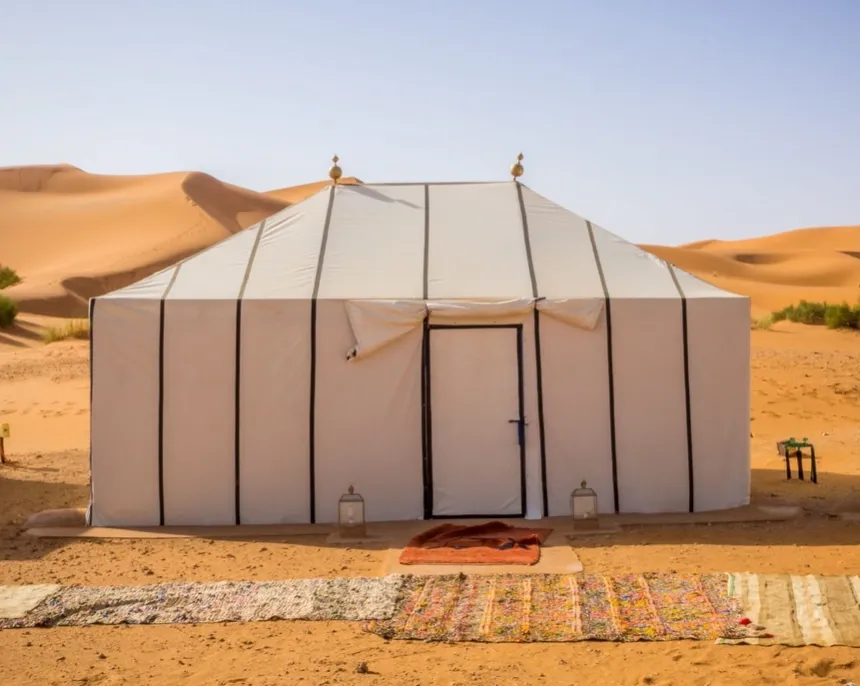
A traditional Bedouin camping setup centres on the beit al-sha'ar — the goat-hair woven tent. For a family desert camp, the typical configuration is:
- A single tent bay (approximately 4 × 6 m to 4 × 9 m) for a family of 4–6, divided internally by the woven sahah partition into a sleeping zone and a social zone.
- An open-sided shade extension (a riwaq or side lean-to) attached to one long side of the tent, creating a covered outdoor sitting area where guests and family can gather without entering the main sleeping space.
- A separate fire area positioned 3–4 m from the tent entrance, downwind of the camp, with a simple windbreak of stakes and fabric on three sides.
Why the Goat-Hair Tent Outperforms Modern Alternatives in Desert Conditions
The traditional Bedouin tent material is not just aesthetically authentic — it performs:
- Breathability: The open weave allows warm air to escape through the roof while the tent walls block direct sun and wind. The interior of a correctly erected goat-hair tent is typically 8–12 °C cooler than a sealed synthetic tent under the same midday sun.
- Sand resistance: The matte woven surface does not attract static-charged sand particles the way smooth synthetic fabrics do. Shaking out a goat-hair tent panel takes seconds; cleaning a polished nylon inner tent in a shamal takes considerably longer.
- Cold-night performance: The dead-air pockets in the woven fabric provide meaningful insulation when the desert temperature drops after midnight — relevant at Al Qudra in January and essential at Liwa on a clear January night.
- Rain response: When wet, the woven goat hair swells and the weave closes, making the canopy nearly waterproof within minutes of rain contact.
Setting Up the Majlis: What You Need
A proper Bedouin-style desert majlis requires more than just a tent. The seating and serving setup:
- Floor covering: A traditional woven rug (bissat) covering the full floor area of the social zone, with additional reed or palm-leaf mats (hassir) at the perimeter for informal seating.
- Cushions and bolsters: Floor-level seating with large cushions against the tent walls and bolsters for reclining — the seated height is around 300 mm, lower than Western furniture.
- Coffee service: The dallah (Arabic coffee pot) and finjan (small cups) on a low tray within reach of the host. Coffee is typically brewed on an open fire just outside the tent entrance and brought in continuously.
- Date tray: A platter of fresh or dried dates, present at all times in a traditional Bedouin majlis.
- Incense: An oud or bakhoor incense burner positioned near the entrance to scent the tent and signal welcome to approaching guests.
Food and Cooking in a Bedouin Desert Camp
The traditional cooking method for a Bedouin camp is the open wood or charcoal fire, positioned away from the main tent. Key dishes for a UAE desert camp:
- Harees: Slow-cooked wheat and meat — can be prepared in a covered pot over the campfire for 3–4 hours.
- Machboos: Spiced rice and meat, requires a controlled heat source — a two-burner gas stove under the windbreak shade is the practical option.
- Grilled meats (mashawi): Skewers or a flat grill over the campfire — the simplest and most social cooking method for a desert camp.
- Bread (khubz): Flat unleavened bread on a saj (convex iron griddle) over the fire — the traditional Bedouin staple that requires no additional equipment beyond the fire and griddle.
Planning a Bedouin Camp Experience: Checklist
Everything needed for a complete traditional Bedouin desert camp setup for 6–10 people:
- Beit al-sha'ar tent (9 m × 4 m minimum), complete with centre poles, side poles, ridge rope, and stakes
- Riwaq side extension (4 m × 3 m)
- Woven rugs and sitting cushions
- Windbreak stakes and fabric for the fire area
- Coffee, dates, incense, and serving equipment
- Cooking fuel (wood, charcoal, or gas)
- Lighting: LED lanterns and battery-powered string lights
- Sleeping gear for inside the tent
Hire or Buy a Bedouin Tent for Your Camp
Arab Muzalat supplies traditional Bedouin tents in sizes from 4 × 4 m family setups to 9 × 18 m multi-bay structures for group camps, corporate desert experiences, and cultural events. We also advise on setup and provide delivery to desert sites across Dubai, Abu Dhabi, Sharjah, and Ras Al Khaimah. Contact us to discuss your camp requirements.