What Is a Beit Al Shaar?
The beit al shaar — بيت الشعر — literally translates as "house of hair." It is the traditional woven tent of the Arabian Peninsula Bedouin, constructed from panels of hand-woven fabric made from the hair of goats, camels, or sheep. The beit al shaar is one of the oldest continuously used dwelling forms in the world — versions of it have been woven, erected, and lived in across the Arabian desert for at least 3,000 years.
In the UAE, the beit al shaar is experiencing a significant revival. What was once a purely functional dwelling is now commissioned as a luxury heritage statement: a high-quality modern beit al shaar installed in a villa garden or farm property communicates a deep connection to Bedouin roots and commands considerable respect among guests. Institutions, cultural parks, and heritage events across the UAE commission beit al shaar structures as centrepieces of authentic Gulf cultural experience.
Traditional Construction of Beit Al Shaar
The Fabric
Traditional beit al shaar fabric is woven on a ground loom — a simple horizontal loom pegged to the earth — in strips approximately 60 to 90 cm wide and as long as the tent requires. The most prized fabric is woven from black or dark brown goat hair (sha'r al ma'iz), which has natural water-shedding properties: when wet, the individual hairs swell and the weave tightens, creating a near-waterproof surface. Camel hair (sha'r al jamal) is softer and produces a lighter-coloured fabric with a distinctive lustre. Sheep wool (suf) creates a denser, warmer fabric used primarily in colder-season tents.
The woven strips are joined edge-to-edge with a running stitch to form the tent panels (shiqaq — شقق), which are then assembled into the roof and wall sections of the tent.
The Structure
A traditional beit al shaar is supported by two rows of central poles (awad — أعواد) that carry the ridge of the tent, and a series of shorter peripheral poles (awatid — أواتد) that support the eaves. The tent is tensioned and anchored by ropes (habal — حبل) pegged into the ground. Side walls (ruwaq — رواق) are separate woven panels lashed to the tent eave ropes — they can be rolled up during the day to allow ventilation.
The interior of a traditional beit al shaar is divided by a woven partition (qata' — قاطع) into a men's reception area (al-shiqq — الشق) and a family area (al-mahram — المحرم). The coffee service and incense station are positioned in the men's section near the entrance.
Sizing
Traditional beit al shaar sizing was described in "bays" — the span between two pole supports. A typical family tent was 3 to 5 bays (approximately 6 to 12 m in length) by 3 to 4 m in depth. A Sheikh's formal reception tent was typically 7 to 12 bays (14 to 25 m length) with a correspondingly greater depth and ceiling height. The modern UAE equivalent maintains similar proportions.
Modern Beit Al Shaar: Materials and Methods
A contemporary UAE beit al shaar is engineered for permanent or semi-permanent installation while retaining the visual and cultural authenticity of the traditional form.
Modern Fabric Options
- HDPE woven fabric: High-density polyethylene monofilament yarns woven in a plain or twill weave, typically in natural-fibre colour simulation (black, brown, camel). UV-stabilised, fire-retardant, and waterproof. The most cost-effective modern material that visually approximates traditional goat hair.
- Acrylic-coated polyester: A heavier, more supple fabric with the appearance and drape of woven natural fibre. Acrylic coating provides water resistance and UV stability. Used in high-end heritage beit al shaar commissions for cultural parks and VIP receptions.
- Authentic goat hair or camel hair (heritage commissions): True hand-woven goat or camel hair fabric is still produced by artisan weavers in the UAE, Saudi Arabia, and Oman. The cost is significantly higher (AED 180 to 350 per sq m vs AED 35 to 75 for HDPE), and the lifespan shorter (5 to 10 years). Used only where cultural authenticity is the paramount requirement.
Modern Structural Systems
- Galvanised steel pole system: Round-section galvanised steel poles of 48 to 60 mm diameter replace the traditional wooden poles. Powder-coated in natural wood or dark brown tones to match the tent fabric. Far more durable than wood (20+ years).
- Aluminium ridge beam system: For larger modern beit al shaar structures (over 10 m span), a continuous aluminium ridge beam spans between the pole tops, providing a rigid horizontal datum for the fabric attachment. Creates a more stable structure in wind.
- Concrete foundation anchors: For permanent installations, the central poles are set into 300 to 400 mm diameter concrete foundation pads, allowing the tent to withstand UAE Shamal wind conditions.
Gulf Style Variations for Beit Al Shaar
Emirati / Classic Gulf Style
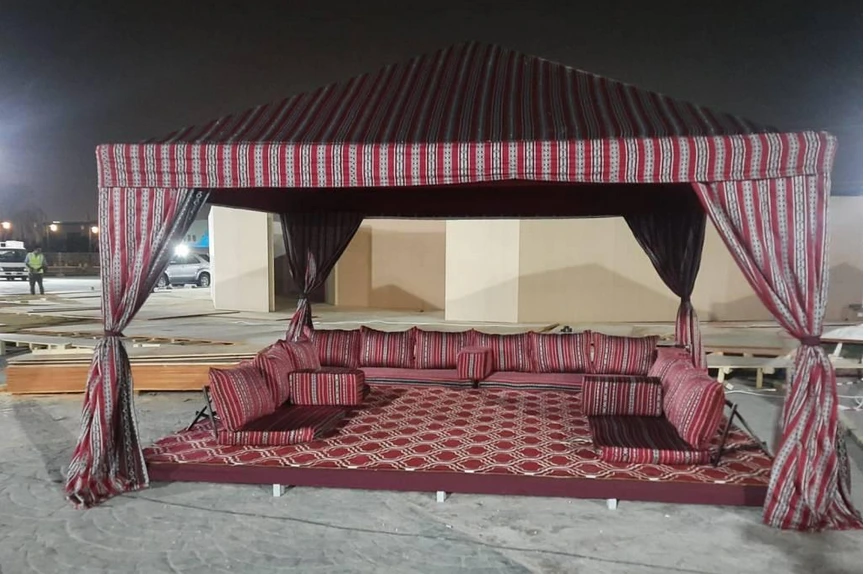
The defining Emirati beit al shaar uses black or very dark brown roof fabric contrasting with cream or undyed camel-hair side wall panels. The tent is furnished inside with traditional sadu-woven floor rugs, low majlis seating, and a dedicated coffee service corner.
Najdi Style (Saudi-influenced)
The Najdi beit al shaar uses a slightly higher ridge profile and often has more decorative tent rope anchoring — plaited and tasselled rope work on the exterior anchor ropes. The interior partition is more prominently decorated with sadu embroidery. Popular for UAE clients of Saudi or Najdi heritage.
Luxury Heritage Style
A contemporary interpretation that retains the beit al shaar silhouette but applies luxury interior design to the inside. Exterior in traditional dark fabric; interior lined with embroidered panels, lit by brass lanterns, and furnished with custom-made low seating in heritage-inspired fabric. Air conditioning via concealed portable units. This is the premium-end beit al shaar now commissioned for high-end UAE villa gardens.
Beit Al Shaar Sizing Guide for UAE
| Style | Dimensions | Interior Area | Seated Capacity |
|---|---|---|---|
| Small family tent | 6 x 4 m | 24 sq m | 10–15 persons |
| Standard reception tent | 10 x 5 m | 50 sq m | 20–30 persons |
| Large tribal/event tent | 15 x 6 m | 90 sq m | 40–60 persons |
| Palace/heritage centrepiece | 20 x 8 m+ | 160+ sq m | 80–120 persons |
Design and Build Your Beit Al Shaar with Arab Muzalat
Arab Muzalat designs and builds beit al shaar tents in all Gulf styles across the UAE — from traditional goat-hair fabric commissions to premium modern heritage interpretations. We handle site survey, structural engineering, fabric selection and fabrication, foundation work, and interior furnishing. Contact us to discuss your beit al shaar project and receive a full design proposal.