
Two Tent Traditions in the UAE
Walk through any outdoor event, desert campsite, or Ramadan reception area in the UAE and you will encounter two distinct tent traditions side by side: the Pakistani tent and the Arabic Bedouin tent. Both are made of fabric stretched over poles, both serve social and ceremonial purposes, and both are deeply embedded in UAE outdoor culture. But they come from entirely different origins, are built in fundamentally different ways, and perform best in different contexts. Understanding the difference saves you from ordering the wrong tent for your event — and helps you appreciate why each tradition has persisted independently in the same market.
Origins and Cultural Background
The Arabic Bedouin Tent
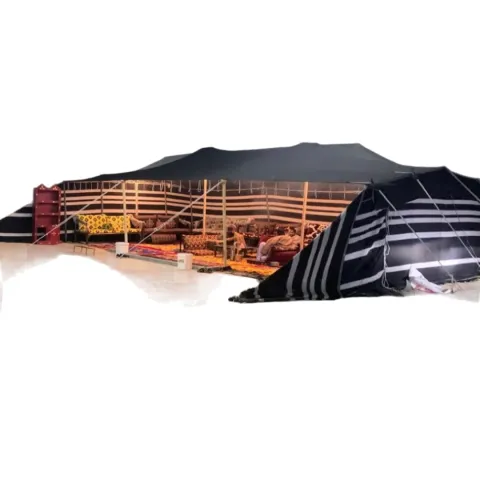
The Arabic tent — known as the bayt al-sha-r (house of hair) or simply the Bedouin tent — developed over thousands of years in the Arabian Peninsula, the Levant, and North Africa. It was the primary dwelling of nomadic Arab tribes moving seasonally across desert terrain. Every structural and material choice reflects the demands of desert life: the low profile reduces wind resistance; the dark wool fabric absorbs heat during cold desert nights and reflects it during the day through the natural lanolin in the fibres; the open sides allow cross-ventilation in the intense summer heat.
In the UAE context, the Bedouin tent is a symbol of national heritage. It appears at heritage festivals, camping events, and government-sponsored cultural celebrations as a deliberate reference to the pre-oil founding culture of the country.
The Pakistani Tent
The Pakistani tent tradition developed in the artisan workshops of Punjab and Sindh, where skilled craftsmen produced elaborate fabric structures for Mughal court ceremonies, Sufi shrine festivals (melas), and large outdoor weddings (barat functions). The aesthetic draws from Persian, Mughal, and Central Asian influences — bold geometric and floral prints, rich jewel-toned colour combinations, and ornate border treatments.
Pakistani tent makers emigrated to the Gulf in large numbers during the oil boom of the 1970s and 1980s, bringing their craft with them. Their tents rapidly became the standard choice for outdoor events requiring affordable scale and visual impact — a role they continue to fill across the UAE today.
Construction and Structure
FeatureArabic Bedouin TentPakistani Tent Primary polesRidge poles (awsat) along the centre line, typically 2–5 poles in a rowSingle or multiple centre poles at the peak; some designs have a ridge pole Roof profileLow, gently sloping; ridge is straight and horizontalHigher peaked apex; more pronounced point at each pole position Side wallsRemovable woven panels (ruaq) pinned to the eave; traditionally left partially openSewn fabric side panels tied to eave rope; fully closable Front openingWide open front face (wajha) with no permanent closureEntrance vestibule with decorative valance; can be fully enclosed Guy ropesNumerous guy ropes (atad) staked into the ground at a shallow angle; critical for stabilityFewer guys; stability comes more from the centre pole base plates Footprint shapeLong and narrow; typically 2:1 to 3:1 length-to-width ratioMore square or rectangular; 1:1 to 1:2 ratio common Fabric and Materials
Arabic Bedouin Tent Fabric
Traditional Bedouin tents are woven from goat hair (sha-r al-ma-z) or a blend of goat hair and camel wool. The natural fibres produce a fabric that swells when wet — effectively self-sealing in rain — and breathes freely in heat. The colour is almost always natural dark brown or black, or undyed cream for the inner partition panels (qata).
Modern Bedouin tents available in the UAE are frequently made from acrylic canvas that mimics the weave pattern and colour of traditional wool, at lower weight and cost. Some suppliers use a wool-acrylic blend as a compromise between authenticity and practicality.
Pakistani Tent Fabric
Pakistani tents use cotton, polyester-cotton blend, or synthetic canvas printed or dyed with bold patterns. The fabric is typically 200 to 350 gsm — lighter than Bedouin canvas — and available in a wide spectrum of colours. The valance borders are often a separate, heavier fabric with embroidered, appliqued, or block-printed decoration.
The characteristic visual element — the ornate printed panel — has no equivalent in the Bedouin tradition. Where Bedouin tent fabric communicates through texture and natural material, Pakistani tent fabric communicates through colour, pattern, and applied decoration.
Aesthetic and Visual Character
The visual difference between a Pakistani tent and an Arabic Bedouin tent is immediately apparent and impossible to confuse:
- The Bedouin tent is earthy, horizontal, and monochromatic. Its beauty lies in the weave of the fabric, the geometry of the guy ropes, and the relationship between the structure and the landscape. It looks as if it grew out of the desert floor.
- The Pakistani tent is vertical, colourful, and decorative. Its beauty lies in the contrast of jewel-toned fabrics, the ornate valance border, and the festive silhouette of the peaked roof. It announces a celebration.
This visual difference explains why they are used for different occasions in the UAE, even though both are capable of sheltering the same number of people in the same space.
Cultural and Social Use
ContextArabic Bedouin TentPakistani Tent Heritage and national festivalsPrimary choice — authentic cultural symbolRarely used — perceived as non-local Desert campingPrimary choice — suited to desert environmentLess common — less suited to sandy terrain Ramadan community iftarUsed for heritage-themed iftarsMost common choice for large community iftars Eid family receptionUsed by some UAE national families for traditional settingsMost widely used for Eid reception tents WeddingsTraditional Emirati weddings; tribal reception areasSouth Asian UAE weddings; mixed-community events Corporate outdoor eventsUsed when UAE heritage theme is requiredUsed for general outdoor event hosting Labour camp shadeNot usedPlain-canvas variant widely used Practical Performance Comparison
Wind Resistance
The Bedouin tent has significantly better wind resistance in open desert conditions. Its low profile and extensive guy-rope system are designed for the shamal and haboob wind conditions of the Arabian Peninsula. Pakistani tents, with their higher peaked profile, catch more wind and require more careful staking in exposed locations.
Rain Performance
Traditional Bedouin tent wool swells when wet and becomes largely waterproof. Modern acrylic versions are water-resistant. Pakistani tent canvas is water-resistant in light rain but can leak at seams in heavy rain. Neither performs as well as a properly sealed PVC marquee in sustained rainfall.
Ventilation
The open-sided Bedouin tent excels at natural ventilation — its entire design is oriented around airflow. Pakistani tents with panels closed can become very warm without active air conditioning. For outdoor events in UAE summer without A/C, a Bedouin tent is more comfortable.
Setup Complexity
Both tents can be erected without specialised tools, but the Bedouin tent requires more skill and experience to tension correctly — too loose and it sags; too tight and it risks pole failure in wind. Pakistani tents are more forgiving of non-expert installation.
Cost Comparison
ItemArabic Bedouin TentPakistani Tent Rental (10 x 10 m, 3 days)AED 2,000 – 4,000AED 1,500 – 3,000 Purchase (10 x 10 m, standard)AED 6,000 – 14,000AED 4,000 – 9,000 Purchase (10 x 10 m, premium)AED 18,000 – 35,000 (hand-woven wool)AED 9,000 – 18,000 (royal embroidered) Bedouin tents — particularly those made from genuine hand-woven wool — command a price premium reflecting the skilled craft labour involved. Pakistani tent production benefits from higher-volume, mechanised processes that keep costs lower at equivalent sizes.
Which Should You Choose?
The decision is straightforward once you know the event context:
- Choose a Bedouin tent when the event has a UAE heritage theme, takes place in a desert or rural setting, or requires the cultural authenticity that only a traditional Arabic tent structure communicates.
- Choose a Pakistani tent when you need maximum visual impact and atmosphere for the budget, the event is a community gathering or celebration where a festive appearance is the goal, and the setting is a garden, compound, or urban outdoor space.
- Use both together when the event is large enough to benefit from different zones — a Pakistani tent for the main seating area and a Bedouin tent at the entrance or as a dedicated heritage reception area creates a layered, memorable event space.
Arab Muzalat: Both Tent Traditions, One Supplier
Arab Muzalat stocks, rents, and installs both Pakistani tents and Arabic Bedouin tents across Abu Dhabi, Dubai, Sharjah, and the Northern Emirates. Our team can advise on the right choice for your event, your location, and your budget. Contact us to check availability and receive a quote within 24 hours.