Walk through any UAE residential area or commercial car park and you will see car shades that look completely different from each other — some with curved roofs, some flat, some built from fabric, some from solid panels, some that retract and some that don't move at all. These differences are not just aesthetic. Each variation reflects a different engineering choice, a different material property, and a different use case.
This guide organises every UAE car shade type across four dimensions: what the structure looks like, what the canopy is made from, how it operates, and what situation it is best suited for. If you have been trying to compare car shade options and found the terminology confusing, this is the reference to bookmark.
Dimension 1: Structural Frame Type
The frame is the skeleton of the car shade. It determines the load path (how wind and gravity forces are carried to the ground), the visual appearance, and the cost of the structure.
Cantilever Car Shade (الكابولي)
What it looks like: A single column on one side, with a horizontal or angled arm extending across the parking space to the other side. No column on the inside edge — the entire canopy is supported from one side.
Engineering: The single column must resist the full bending moment caused by the offset load. This means a larger column section and deeper footing than a two-column structure of the same span. The foundation carries all the load asymmetrically.
Best for: Villa driveways where a column on the inside would block door access. Properties where the column must be positioned against a wall or fence on one side.
Not ideal for: Wide multi-bay installations where the bending loads become very large. Soft ground conditions where deeper footings significantly increase cost.
H-Frame Car Shade (إطار H)
What it looks like: Two columns — one on each side — connected by a horizontal crossbeam at the top. The canopy attaches to the crossbeam and runs forward and backward from it.
Engineering: The simplest and most efficient structural form. Load from the canopy is shared equally between the two columns. Foundation requirements are lower than cantilever for the same span.
Best for: Cost-sensitive residential installations, narrow driveways, any situation where a column on both sides is acceptable. The most common structure type in UAE residential areas.
Not ideal for: Sites where columns on both sides obstruct vehicle or pedestrian access.
Arch Frame Car Shade (الإطار القوسي)
What it looks like: Columns on both sides, with the canopy following a curved or arched profile from one side to the other. The peak of the arch is at the centre.
Engineering: The arch shape converts bending forces into compression, making it structurally efficient for longer spans. The curved form also improves wind resistance by reducing flat surface area exposed to horizontal wind loads.
Best for: Villa and compound installations where aesthetic quality matters. Driveways visible from the street where the shade structure should look intentional rather than utilitarian.
Not ideal for: Budget-constrained projects — the curved fabrication increases cost over a simple H-frame.
Hip-Roof Frame Car Shade (السقف المائل)
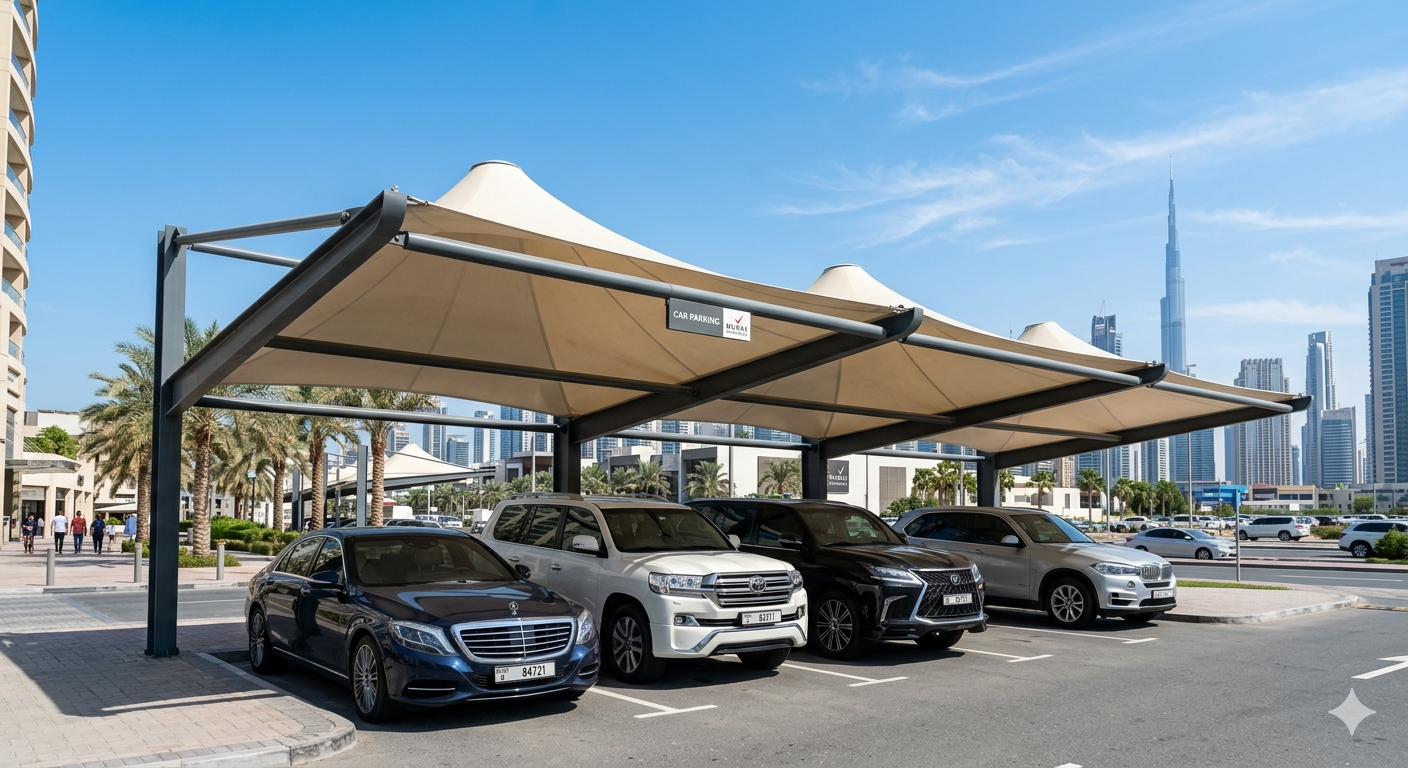
What it looks like: A four-sided peaked roof, with the canopy sloping upward to a central ridge and then down on all four sides. Resembles a traditional pavilion roof in shape.
Engineering: Excellent water drainage in all four directions. Wind resistance is good because no large flat surface faces any single wind direction.
Best for: Premium residential and commercial installations. Locations where rain protection matters alongside sun protection. Properties with a formal architectural style.
Not ideal for: Low-clearance sites — the sloped sides reduce usable clearance at the perimeter of the structure.
Butterfly (Inverted-V) Car Shade (الفراشة)
What it looks like: The canopy rises from both sides toward a central ridge, creating a V shape in cross-section when viewed from the front. The highest point is at the centre, not at the sides.
Engineering: Sheds water to both sides. Provides maximum clearance height at the centre of the parking space — useful for tall vehicles. The upward-sloping edges create visual openness.
Best for: Sites with good drainage on both sides. Multi-bay rows where maximum central clearance is needed. Modern and contemporary visual aesthetics.
Not ideal for: Sites with drainage constraints along both sides simultaneously, as both edges shed water outward.
Sail Shade (Tensile) Car Shade (الشراع)
What it looks like: A fabric membrane tensioned between anchor points at different heights, creating a curved saddle or swooping form. No central frame — just fabric under tension between posts.
Engineering: Tensile structures are efficient in tension but require precise geometry — the shape must be designed so all points of the fabric are under tension at all times, even under variable loads. Under-tensioned sails flutter and fail at sail edges. Requires anchor points that can resist the high outward tension forces.
Best for: Covering irregular-shaped areas that do not suit rectangular framed structures. Supplementing existing structures. Architectural feature installations where form matters as much as function.
Not ideal for: High-traffic commercial car parks where ease of canopy replacement and maintenance matters. Sites with no suitable anchor points for the tension forces.
Pyramid Car Shade (الهرم)
What it looks like: A single central column with the canopy radiating outward and downward in all directions from a central peak. Circular or square plan form.
Engineering: All loads concentrate on the single central column. Efficient for small square or circular footprints but becomes uneconomical at larger spans.
Best for: Single-bay installations in open areas with access from all four sides. Decorative installations where the striking visual form justifies the cost.
Not ideal for: Multi-bay layouts (pyramids do not tile efficiently). Long narrow driveways.
Dimension 2: Canopy Material Type
The canopy is the surface that blocks the sun. The frame type determines the structure; the material determines the shade factor, durability, heat management, and cost.
HDPE Shade Cloth
What it is: High-density polyethylene monofilament yarn woven into an open-weave fabric. The weave density determines the shade factor: 70% shade cloth lets 30% of light through; 90% shade cloth lets 10% through.
Properties: Breathable (air and some light pass through), UV-stabilised, lightweight, flexible. Fades and loses tensile strength over 5 to 7 years under UAE sun.
Best for: The majority of UAE residential and commercial car shade installations. Available in all standard colours. Easily replaced when worn.
Shade factor range: 70%, 80%, 90%, 95% available in UAE market.
PVC-Coated Polyester Fabric
What it is: A woven polyester base fabric coated on both sides with PVC. The result is a fully waterproof, opaque, flexible sheet.
Properties: Zero breathability — no air or light passes through. Fully waterproof. Heavier than HDPE. Creates higher heat buildup underneath due to no airflow. More resistant to tearing than HDPE.
Best for: Covered walkways and canopies where rain protection is the primary goal. Locations where insect or dust penetration through the canopy is a concern.
Not ideal for: Open car parks where heat buildup under the canopy is a problem. UAE summer conditions where airflow under the shade is important for comfort.
Polycarbonate Panels
What it is: Rigid thermoplastic panels in single-wall, twin-wall, or multi-wall configurations. Available in transparent, tinted, opaque, and opal finishes.
Properties: High impact resistance, excellent UV blocking (with UV-stabilised coating), long service life (12–15 years). Twin-wall polycarbonate has thermal insulation properties. Translucent versions allow natural light while blocking UV. No breathability.
Best for: Premium villa installations. Hotel and luxury compound guest parking. Any installation where a permanent architectural look is required and waterproofing is valued.
Not ideal for: Installations in areas with high wind speeds — polycarbonate panels are heavier and impose more wind load than fabric canopies.
Aluminium Composite Panels (ACP)
What it is: A sandwich panel with two thin aluminium skins bonded to a polyethylene core. Available in a wide range of finishes and colours.
Properties: Fully opaque, rigid, weatherproof, lightweight for a metal product. Does not corrode. Professional finish. No breathability or light transmission.
Best for: Commercial carports where complete weather protection is required and the structure must match a building facade. Industrial yards. Back-of-house hotel parking.
Not ideal for: Standard residential car shades — cost is significantly higher than fabric options for no additional shade benefit.
Fibreglass Reinforced Plastic (FRP) Panels
What it is: Glass fibre strands embedded in a polyester or epoxy resin matrix, moulded into panel form. Available in flat and corrugated profiles.
Properties: Lightweight, corrosion-resistant, available in translucent form. Less brittle than polycarbonate at impact. UV coating required for UAE outdoor use.
Best for: Semi-industrial applications where light transmission is useful but full polycarbonate cost is not justified. Agricultural and farm shade structures in UAE.
Dimension 3: How It Operates
Fixed Car Shade
The frame and canopy stay in position year-round. No moving parts. The most common type in UAE residential and commercial installations. Requires a municipality permit for installation. Lowest cost per square metre of covered area. Maintenance is periodic inspection and canopy cleaning only.
Manual Retractable Car Shade
The canopy rolls or folds on a manually operated mechanism — typically a hand crank or pull cord. The shade can be opened on sunny days and retracted when shade is not needed or before an approaching dust storm. No electrical connection required. More complex mechanism than a fixed shade means more maintenance points. Cost is 25–40% higher than a fixed equivalent.
Motorised Retractable Car Shade
The canopy operates on an electric motor controlled by a wall switch, remote control, or smartphone app. The most convenient option — the shade opens and closes without physical effort. Some systems include a wind sensor that automatically retracts the canopy when wind speed exceeds a safe threshold. Cost is 40–70% higher than a fixed equivalent. Requires an electrical connection point near the installation.
Portable (Freestanding) Car Shade
A complete shade structure with no ground anchors — the frame stands on weighted base feet or sandbag ballast. No installation, no permit, no modification to the parking surface. Can be moved and repositioned. Suitable for apartment building car parks, rented properties, and temporary event shade. Load capacity is lower than anchored structures — not suitable for high-wind locations or permanent use in exposed areas.
Dimension 4: Situation and Use Case
Villa Driveway (Single or Double Bay)
The most common UAE residential scenario. A fixed cantilever or arch-frame shade in HDPE fabric covers one or two vehicles. The structure typically mounts into a concrete driveway with core-drilled footings and requires a municipality permit. Design should consider the villa facade and any HOA restrictions on colour and style.
Apartment or Rented Property (No Anchoring Permitted)
Portable freestanding shades are the only option when landlord approval for permanent installation cannot be obtained. Weighted base alternatives include sandbag ballast frames and water-ballast bases. Cover one vehicle adequately. Fabric shade type is always HDPE at 70–80% shade factor for adequate UV protection.
Residential Compound (Multi-Bay Row)
Community management installations covering resident and visitor parking. H-frame or arch-frame row systems in double-row back-to-back configuration are the most cost-efficient at this scale. Standard 90% HDPE fabric. Engineering and permits are handled by the supplier on behalf of the community management company.
Commercial Office or Retail Car Park
Multi-row systems engineered to UAE wind load standards with stamped structural drawings. Polycarbonate or high-spec HDPE depending on the building's grade and tenant expectations. Clearance height set to accommodate the full range of staff and visitor vehicles.
Farm or Agricultural Property (Al Ain, Fujairah Interior)
UAE agricultural properties, particularly in Al Ain and the interior of Fujairah, use larger-span shade structures for equipment and vehicle storage. FRP or heavy-duty metal panel canopies on wide-span steel frames. Ground conditions on agricultural land vary — compacted earth footings are sometimes used where concrete infrastructure is not available.
Which Type Is Right for You? A Decision Guide
SituationRecommended StructureRecommended MaterialFixed or Retractable Villa driveway (1–2 bays), column both sides OKH-frame or archHDPE 90%Fixed Villa driveway, no inside columnCantileverHDPE 90%Fixed Villa, premium look requiredHip-roof or archPolycarbonate or HDPEFixed or motorised Apartment, no anchor permittedPortable freestandingHDPE 70–80%N/A (portable) Compound (10–100+ bays)H-frame double rowHDPE 90%Fixed Hotel or luxury commercialArch or hip-roofPolycarbonateFixed Industrial yardH-frame, wide spanMetal panel or FRPFixed Irregular shape / featureSail (tensile)HDPE or PVCFixed Frequently Asked Questions
What is the most common type of car shade in UAE?
The single-bay HDPE cantilever and H-frame shades dominate UAE residential installations. In commercial settings, the double-row H-frame system in HDPE is the most widely installed. Polycarbonate arch and hip-roof shades are common in premium residential and hospitality settings.
Which car shade type lasts longest in UAE conditions?
The frame lasts 15 to 25 years when properly galvanised and maintained. The canopy lifespan varies by material: polycarbonate panels last 12 to 15 years, metal panels 20+ years, HDPE fabric 5 to 7 years, PVC fabric 7 to 10 years. The choice of frame type does not significantly affect frame longevity — the material and coating quality determine frame life.
Is a cantilever car shade stronger than an H-frame?
Not necessarily stronger — differently loaded. An H-frame shares load across two columns and is structurally simpler. A cantilever concentrates all load on one column, which requires a heavier column and deeper footing to achieve the same wind resistance. A well-designed cantilever and a well-designed H-frame are equally safe — the engineering is just different.
Can I mix structure types — for example, a cantilever for one bay and an H-frame for another?
Yes, and this is sometimes done in complex driveways where access constraints differ from one part of the parking area to another. The structures must be designed to be independent of each other (not relying on shared loads) or fully integrated by an engineer if they share any structural elements.
What type of car shade provides the most cooling effect underneath?
HDPE shade cloth at 90% shade factor provides the best combination of UV blocking and airflow. The breathable weave allows air to move through the canopy, preventing the greenhouse heat buildup that solid materials create. Polycarbonate and metal panels block more solar radiation but trap hot air underneath unless the structure is open-sided. In UAE conditions, HDPE fabric in a well-ventilated structure produces the most comfortable environment under the shade.
Contact Arab Muzalat to discuss the right car shade type for your specific property, vehicle, and location — we supply and install all structural types and canopy materials across the UAE.